 PoshanSense
Is hummus a better snack than granola bars?
US and Spanish experiments show why hummus can be a useful snack without guaranteeing greater fullness, lower daily calories or weight loss.
Research explained · Published 2020 & 2021
The mid-afternoon choice is familiar: open a snack bar or reach for something savoury. Hummus looks like the obvious healthier option, with chickpeas at the centre and a reputation for being filling. But a health halo is not the same as an answer.
Hummus may work well for you. The more useful question is what it replaces, what you eat with it and what “better” means. Greater fullness, a smaller glucose response, better nutrient variety and fewer calories across the whole day are separate outcomes.
One snack changed later dessert choices
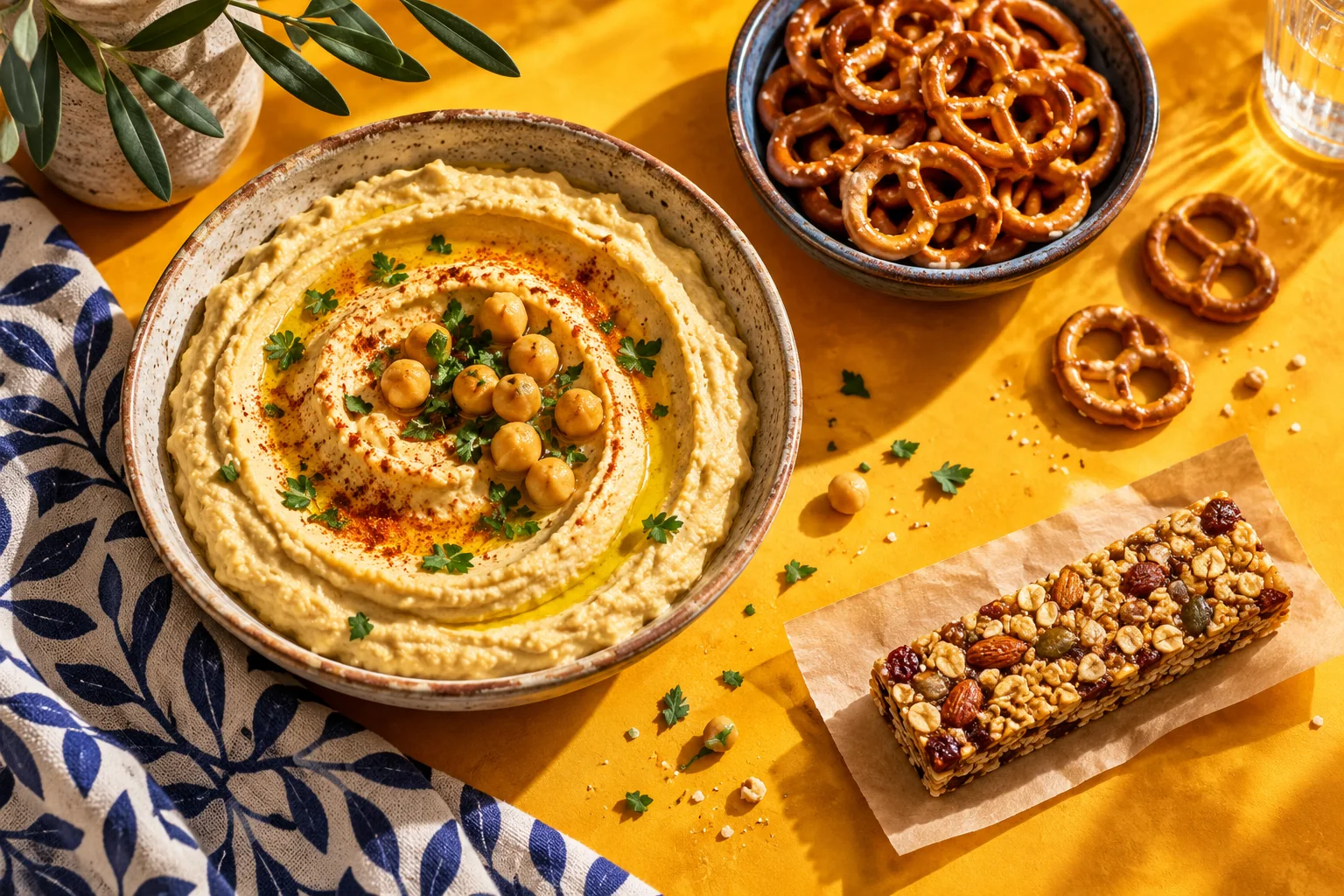
A US crossover trial compared hummus and pretzels with granola bars and with no afternoon snack. The two snack options supplied the same energy but differed in ingredients and nutrients. The hummus combination contained less sugar and somewhat more protein than the bars.
After the hummus pattern, participants ate less dessert-type food in the evening than after the other patterns. That is an interesting change in food choice. The study did not clearly establish that total daily energy was lower, and it did not test weight loss.
Hummus did not win every comparison
Both snack options delayed requests to eat again compared with no snack. Hummus did not clearly beat bars on every fullness or hunger measure. Its afternoon glucose response was lower than the bars’ response, but the whole-day glucose measures did not show the same clear advantage.
That distinction matters. The participants were healthy habitual snackers; this was not a trial treating diabetes. A result over a few afternoon hours should not become a claim about reversing a condition.
The trial was funded by Sabra Dipping Company, and an author disclosed advisory-board involvement. Those disclosures do not erase the result, but they are part of its context alongside the short duration and whole-snack comparison.
A Spanish study adds a useful reality check
In Murcia, Spain, 24 adults completed four test visits involving hummus, gazpacho, ajoblanco or white bread. Portions were matched for energy and total volume with water. The researchers recorded appetite and weighed a pizza meal three hours later.
Hummus did not clearly differ from bread or ajoblanco across the appetite comparisons, and pizza intake did not clearly differ between any of the four conditions. The soup sometimes produced stronger appetite ratings, but the numerical trend towards less pizza was not a proven difference.
This publicly funded study reported no conflicts. Together, the two experiments make a more balanced story than either a blanket endorsement or dismissal: hummus can be useful, while the response depends on the snack and comparison.
The dip is only one part of the snack
Hummus
Compare the product and amount, not just the chickpea name.
Dipper
Pretzels were part of the trial snack; other accompaniments change the comparison.
Later eating
Less dessert snacking did not establish a lower total daily energy intake.
Personal fit
Taste, hunger, convenience and the rest of the day remain relevant.
Choose a snack, not an ingredient in isolation
A dip eaten with a large packet of crackers is a different snack from a smaller portion eaten with another accompaniment. Homemade and packaged versions also vary. Compare the amounts you would actually eat, including the dipper, instead of treating the hummus name as a nutritional score.
Similarly, granola bars are not one fixed recipe. A trial of particular bars cannot condemn every product carrying that name. The ingredient list, serving size and your preference matter more than copying a study’s brand choice.
If you enjoy hummus, it can be a convenient way to include chickpeas in a snack. If it leaves you unsatisfied or you dislike it, the experiments do not oblige you to eat it. There is no reason to add a snack merely because one combination performed well against another.
Try noticing whether the option fits your appetite and routine. Keep the complete snack visible in your journal, and consider later eating without expecting automatic compensation. A sensible alternative can earn its place through usefulness, without promising to cancel its calories or produce weight loss.
Sources & further reading
- United States · afternoon snacks and later eating (2020)
- Spanish crossover comparison of hummus, gazpacho, ajoblanco and bread
Study years differ from this article’s publication date. We reviewed full primary papers and relevant supporting material; access limitations are kept out of efficacy claims. Original illustrations and diagrams; no publisher figures reproduced. Educational writing, not clinical review.
Published 11 October 2026 · Sources checked 11 October 2026. Suggest a correction.