 PoshanSense
Hunger and thirst: what a Nobel-linked mouse study actually found
A 2025 mouse study explored brain circuits involved in eating and drinking. The Nobel connection, the sample sizes and why this is not a human diet tip.
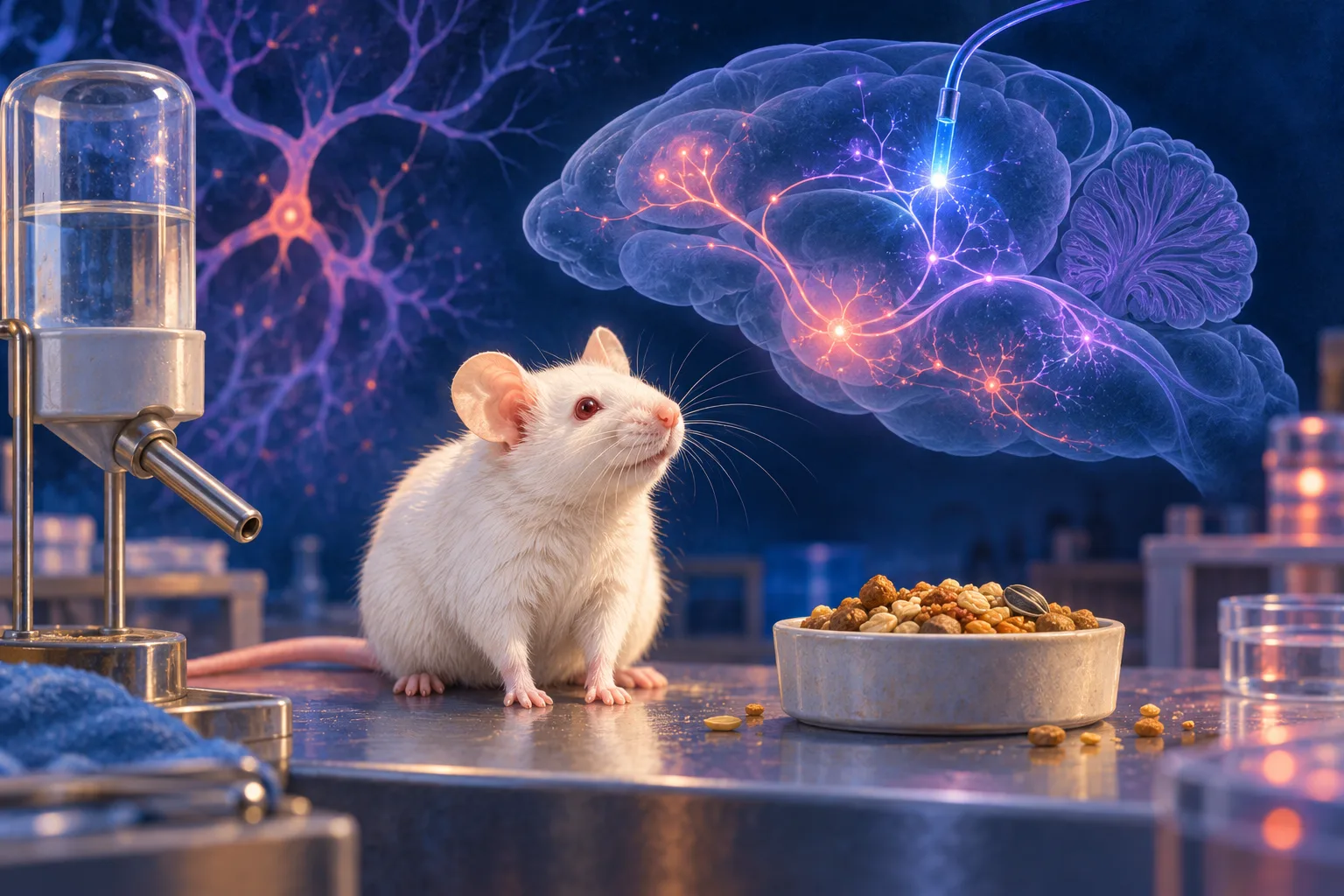
Mouse experiments · Nature Communications · Paper published 29 March 2025
Why do we reach for food at one moment and water at another? It is a fascinating question, especially when Nobel news brings brain science into our everyday feeds. But a headline about neurons can travel a long way before it reaches your lunch table. Let’s keep the laboratory context attached.
How the study worked
Researchers selected two neuron populations in adult mice, made them responsive to light using genetic tools and compared activation with control mice without active ChR2. They weighed food consumed and measured water intake in short tests: 40 minutes for feeding and 30 for drinking. In figure 4c, the analysed Htr2a groups had 10 control and 9 activated mice; the Sst groups had 10 and 11. Other experiments used other counts. This was several small animal experiments, not one large human trial.
First, what is the Nobel connection?
Karl Deisseroth shares the 2026 Nobel Prize in Physiology or Medicine for optogenetics with Peter Hegemann and Georg Nagel. Optogenetics combines genetic methods with light to control selected cells in experiments. Think of it as giving researchers a more selective way to ask what happens when a particular group of neurons is active. It is not shining an ordinary torch at someone’s head. Stanford’s award announcement explains the technique.
Deisseroth is a coauthor of this 2025 paper, but it is not the paper that won the prize. Federica Fermani and Rüdiger Klein designed the study; Deisseroth and Charu Ramakrishnan contributed genetic tools. Credit the experiment and the broader method separately.
What did the researchers find?
In the medial central amygdala, activating Htr2a-labelled neurons promoted both eating and drinking. Activating Sst-labelled neurons promoted drinking, without a statistically clear increase in eating in the feeding test. The pattern overlaps: it is not a neat pair of independent hunger-only and thirst-only switches.
Two patterns. An overlap.
Water ↑
No clear food increase
How to read that result
The names Htr2a and Sst identify the cell populations selected for these experiments. You do not need to memorise them. The useful distinction is between an observation of behaviour and a report of experience. A mouse consuming more food is a measurable behaviour; it cannot tell the researchers, in words, exactly how hungry it feels.
An analogy may help. Imagine testing two routes through a railway junction. One route reaches two destinations; another reaches one. That tells you something about the routes you tested. It does not provide a complete map of every journey. This analogy describes our interpretation of the experiment’s logic, not the physical layout of a brain.
The small-study details matter
The reporting summary says group allocation was random, but investigators knew genotype and treatment. Sample sizes were not predetermined statistically. Animals with unsuitable placements or injections were excluded; the main methods also describe excluding very low or absent virus expression. Funding came from the Max Planck Society and the European Research Council; the authors declared no competing interests.
Does this mean hunger is really thirst?
No. This experiment does not establish that claim. Nor does it test whether people should drink water instead of eating, whether a supplement changes these circuits, or whether a food-journalling app affects them. Translating an animal experiment into a personal dietary instruction would add questions that were never answered here.
When a caption jumps from neurons to a promise about weight or a product, ask: Was that claim tested in people? What was compared and measured? A famous name cannot supply the missing evidence.
A useful connection to everyday food
Our practical interpretation is modest: separate what you record from what you infer. A meal record might say that lunch was two rotis, dal and curd, with the portion sizes you used. That is a description. A statement that a particular brain circuit caused the meal is a very different claim, and a journal cannot establish it.
PoshanSense can help you log familiar foods and review portions, calories and macros together. Use it as a notebook for meals, rather than a test of your brain or a prediction of a study’s benefits. The app preview below shows the current beta interface with sample journal data.
The question worth taking away is curiosity about how an experiment works. Keep the animal model, comparison and limits in the same conversation as the finding. That makes a research story interesting without turning it into a rule for your next glass of water or plate of food.
Sources & further reading
- Fermani et al. (2025): open-access paper, figures 2 and 4, methods and declarations
- Supplementary information: technical checks, cohorts and additional experiments (PDF)
- Reporting summary: allocation, blinding, exclusions and sample-size decisions (PDF)
- Stanford (5 October 2026): Nobel award and optogenetics background
Findings are paraphrased from Fermani et al., licensed CC BY 4.0. Illustrations are original; they are not publisher figures. Award news is context, not evidence of a dietary benefit.
Published 9 October 2026 · Updated 9 October 2026 · Sources checked 9 October 2026. Suggest a correction.