 PoshanSense
Does peppermint oil help IBS—and does peppermint tea count?
Some trials found symptom improvement; a larger Dutch trial missed its main response endpoints. Why the formulation and outcome matter, and tea is a separate question.
Research explained · Published 2016 & 2020
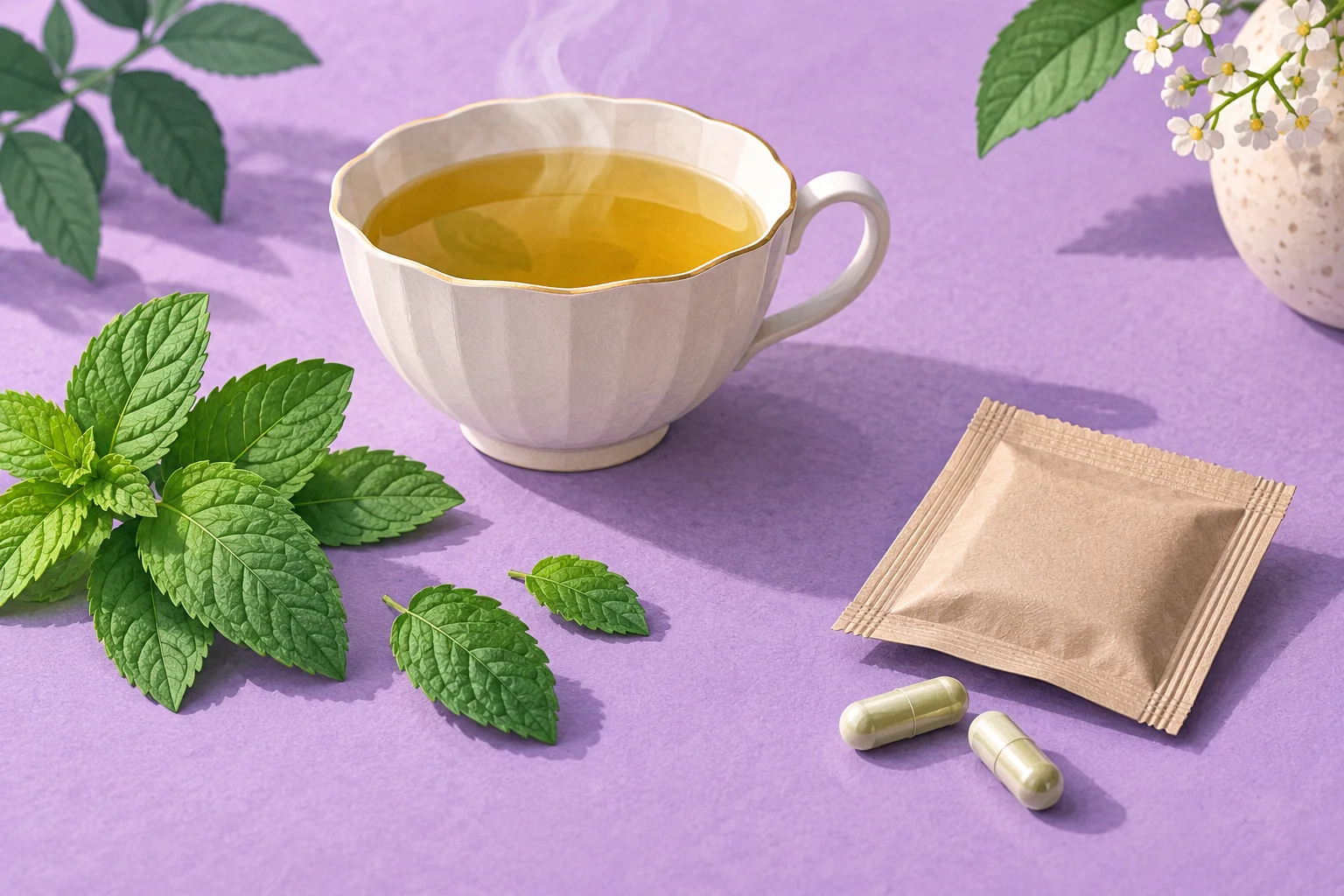
Peppermint appears everywhere: tea after dinner, a digestive sweet, a bottle of essential oil and a capsule marketed for IBS. They share a plant, but they do not share a single body of treatment evidence.
The most useful answer is product-specific
Some trials support improvement in IBS symptoms with a controlled-release oil capsule. That does not establish the same effect for tea, and it does not prove a capsule will help everyone. Before treating all mint products as interchangeable, ask what actually entered the study.
The Dutch PERSUADE trial is particularly useful because it tested two release locations and set clear main outcomes in advance. Neither formulation clearly improved those main endpoints compared with placebo.
How can the main result be null while some symptoms improve?
The small-intestinal product improved some secondary scores, including pain and symptom severity. That can be a signal worth investigating. However, meeting a predefined response criterion over several weeks is a different question from shifting an average score.
Choosing the most positive outcome after seeing all the results would make the answer sound more decisive than the study. Keep both statements together: some secondary improvements occurred, while the main responder and overall-relief comparisons were inconclusive.
Why do other papers sound more enthusiastic?
A smaller US trial randomized 72 adults with mixed or diarrhoea-predominant IBS to a proprietary small-intestinal-release product or placebo. Over four weeks, it found a larger improvement in its total symptom score with peppermint.
That result is not automatically contradicted by the Dutch one. The products, diagnostic criteria, population and main measurements differed. Equally, the smaller positive trial cannot make the larger trial’s null main outcomes disappear. Seventy of the US participants completed; the analysis used a method to handle missing observations.
The US study also had manufacturer-linked authors. That does not invalidate its result, but it is a reason to value independent replication and avoid turning one branded formulation’s result into an endorsement of a whole category.
Same plant, different evidence
Tea
A comforting drink is not the controlled-release product tested.
Capsule
Where and how oil is released can change the intervention.
Outcome
Average symptom improvement differs from meeting a responder endpoint.
Diagnosis
Trials in diagnosed IBS do not identify the cause of new symptoms.
Does tea count?
No direct substitution follows from these trials. Tea delivers a different preparation without the capsule’s controlled release. Someone enjoying a cup after a meal is not reproducing the intervention, and “peppermint helps IBS” is too broad if the product is left unspecified.
Concentrated essential oil is also not a do-it-yourself version of a researched capsule. This article deliberately does not provide ingestion instructions, a dose or a product shopping list.
Natural does not mean free of unwanted effects
The Dutch study recorded more, generally mild, adverse events with the peppermint products. The NCCIH guide describes possible heartburn and other digestive effects. A product intended to help the gut can still make particular symptoms worse.
IBS is a diagnosis, not a name for every uncomfortable meal. New or persistent symptoms deserve assessment rather than repeatedly trying supplements and assuming the cause. Advice should also account for other conditions and medicines.
The practical conclusion
Specific peppermint-oil products are a possible symptom-management discussion, with mixed evidence and tolerability limits. Tea can remain a drink you enjoy without being promoted as an equivalent treatment. Knowing that difference makes the answer more useful than either a miracle claim or a blanket dismissal.
Evidence context: the Dutch study had public ZonMw funding, manufacturer-supplied capsules and disclosed pharmaceutical/licensing relationships. The US paper disclosed manufacturer adviser, consultant and employee roles. Educational information; not clinically reviewed.
Sources & further reading
- Netherlands · PERSUADE trial (2020)
- Full Dutch trial manuscript
- US controlled-release peppermint trial (2016)
- NCCIH peppermint evidence and safety
Study years differ from this article’s publication date. We reviewed full primary papers and relevant supporting material; access limitations are kept out of efficacy claims. Original illustrations and diagrams; no publisher figures reproduced. Educational writing, not clinical review.
Published 11 October 2026 · Sources checked 11 October 2026. Suggest a correction.