 PoshanSense
Aloo is not on trial. Preparation and the replacement food matter.
A 2025 analysis separates fries from other potatoes—and asks the often-missing question: what takes their place?
Underlying paper: The BMJ · Published
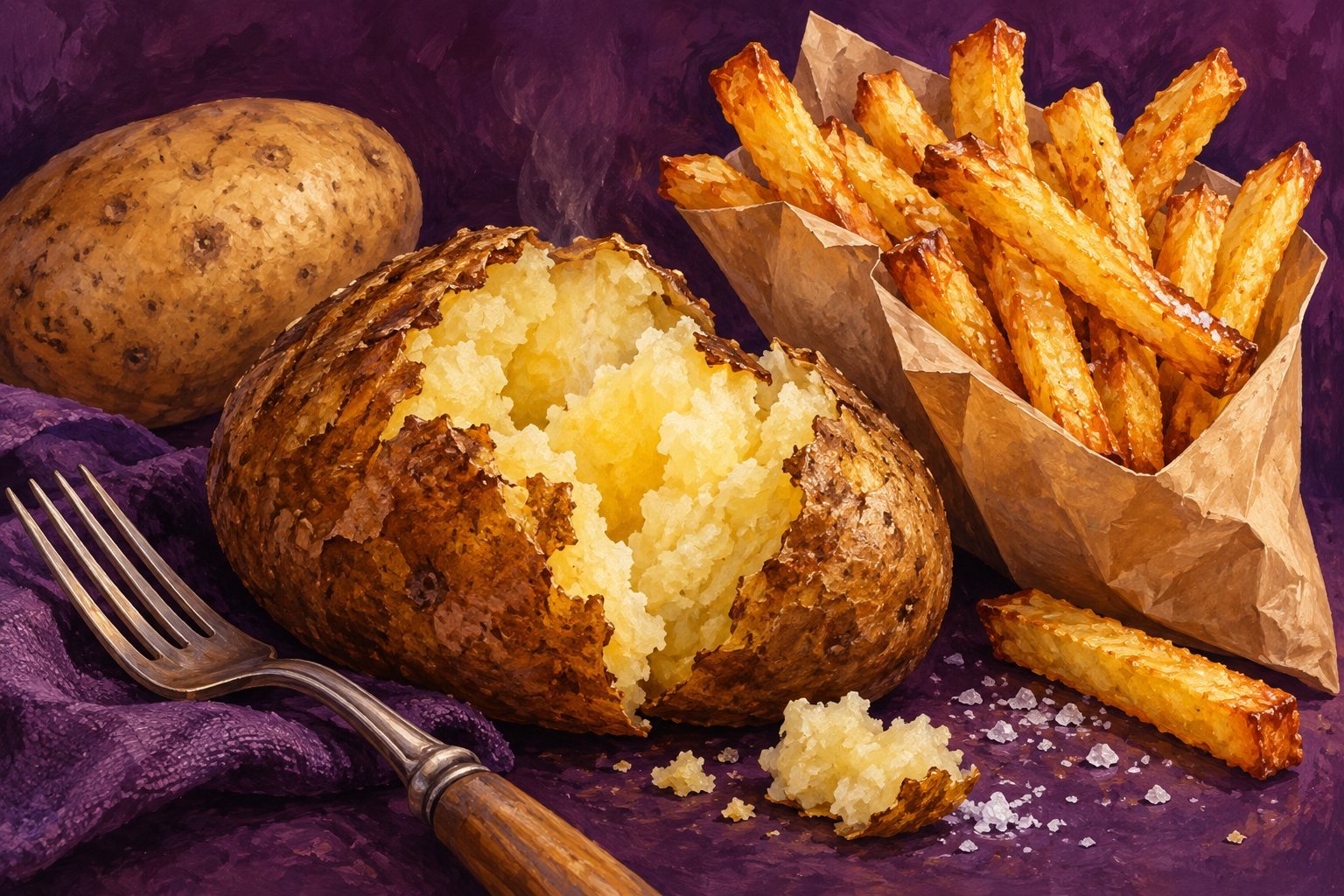
A study result is a clue to understand, not a promise for your body.
Aloo is many things: a sabzi ingredient, a filling, a side dish and an extremely reliable dinner guest. “Potatoes raise diabetes risk” squeezes all those possibilities into one unhelpfully small headline. A 2025 paper took a more specific approach. It looked at preparation, long-term patterns and the food that might replace potatoes. That last detail is doing a surprising amount of work.
What researchers found
Published on 6 August 2025, the analysis included 205,107 adults in three US cohorts. Each additional three weekly servings of fries was associated with a higher type 2 diabetes rate: hazard ratio 1.20 (95% CI 1.12–1.28). Combined baked, boiled or mashed potatoes had no clear association: 1.01 (0.98–1.05). Replacement with whole grains was modelled as favourable; replacement with white rice was not.
The replacement belongs in the question
The limits are not garnish
Diet was self-reported; most participants were US health professionals of European ancestry. Baked, boiled and mashed potatoes were grouped, with limited recipe detail. Indian preparations were not separately tested. Substitutions were statistical estimates. Funding included NIH and other research support; authors reported no relevant financial relationships. A modelled association cannot guarantee the outcome of an actual swap.
Replacing something is different from removing it
“Eat less of this” leaves a blank space on the plate. The blank usually gets filled. Two people could follow the same instruction and choose completely different replacements. The resulting meals would ask different nutrition questions. This is why the replacement is part of the comparison, not a small detail to put after the result.
Imagine changing a commute: replacing a car journey with a train and replacing it with another car are both changes, but not the same change. Food substitutions have their own complexity. An observational model is also different from watching each participant carry out a prescribed swap. The analogy explains the comparison; it does not measure an effect.
What this means for a meal description
Our practical example is a journal entry, not a tested intervention: “aloo sabzi” can be followed by approximate potato quantity, preparation and the rest of the meal. Was it part of dal and roti, or a plate of fries? That context is more useful than attaching a universal verdict to the ingredient. A familiar name does not tell us everything about a recipe.
Do not attach the study’s hazard ratio to your food log. It describes a group comparison over follow-up, not the risk created by one serving today. You cannot multiply it by an estimated portion to calculate your personal chance of illness. The paper also cannot decide whether one specific household recipe belongs in your individual care plan.
A better question than “is aloo bad?”
Ask what food was measured, how often, compared with what, and in which people. Then ask whether your actual meal resembles that description. You may find that the headline has skipped several steps before reaching your kitchen. That is useful information even if it does not produce a dramatic yes-or-no answer.
The sensible takeaway is attention to preparation and comparisons, without assigning moral labels to dinner. If you need dietary advice for diabetes risk or a diagnosis, use a qualified professional who can consider your situation. This study adds a careful question to the conversation. It does not require you to banish a vegetable from the house. Aloo can stay; the vague headline can leave.
A question to keep for the next headline
When the ingredient is the same but the preparation changes, does the headline keep that distinction? Naming both the preparation and replacement makes the comparison easier to inspect.
Sources & further reading
Cover art is AI-generated conceptual illustration, not actual study participants, menus or microscopy. Diagrams are original PoshanSense graphics. Paper figures and publisher images are not reproduced. Examples and practical interpretations are identified in the text.
Published 5 October 2026 · Sources checked 5 October 2026. Suggest a correction.