 PoshanSense
Sugar vs jaggery, honey, stevia and monk fruit: what actually changes?
Is jaggery healthier than sugar? Compare honey, aspartame, stevia and monk fruit, with a 2025 sweeteners trial and clear limits on what it proves.
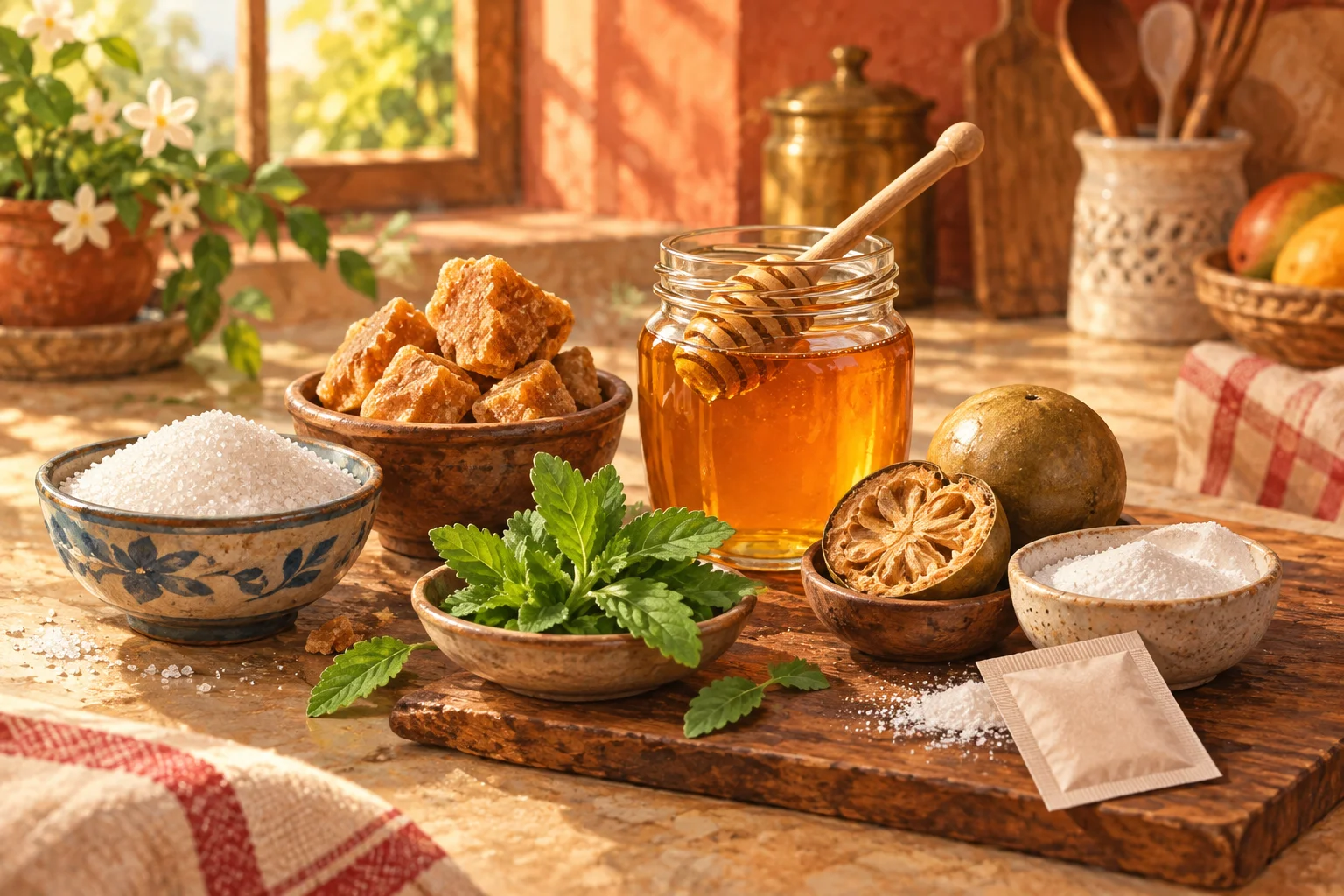
SWEET randomized trial · Nature Metabolism · 7 October 2025
Your chai has acquired a committee: sugar, gur, honey, stevia and a monk fruit blend all want the job. The labels sound persuasive. Natural! Zero sugar! Better for you! Before appointing a winner, ask a more useful question: better for which purpose, in which amount, compared with what? A sweetener can reduce sugar in one recipe without becoming a treatment, a weight-loss plan or a free pass for the whole packet.
Keep these three things together.
Is jaggery or honey healthier than refined sugar?
Refined sugar, jaggery and honey belong on the energy-containing side of this comparison. Swapping the sweetener does not remove the need to account for how much you use. WHO’s definition of free sugars includes sugars added by the cook or consumer, and those naturally present in honey and syrups. Natural origin is not an exemption. WHO’s explanation is about dietary patterns, not whether one familiar ingredient deserves a villain costume.
This article does not have a recent head-to-head human trial ranking all three. We are not claiming they are nutritionally identical, assigning an invented glycaemic index, or declaring a spoonful of gur medicinal. Compare the actual product and portion. Honey is not interchangeable gram-for-gram with dry sugar in a recipe; neither a teaspoon nor a brand name is a standard scientific dose. If you prefer the taste of one, describe that preference honestly rather than turning it into a health claim.
What did the 2025 SWEET trial find?
The open-access SWEET trial included 341 adults and 38 children with overweight or obesity. Adults first followed a two-month weight-loss phase, then a ten-month sugar-reduced diet. One group could replace sugar-rich foods with sweeteners and sweetness enhancers; the other could not. Adults in the sweetener group maintained about 1.6 kg more weight loss at one year. This was a comparison within a structured diet, not a result for a particular sachet.
Only 203 adults completed the year. The intervention used multiple products; it cannot rank aspartame, stevia and monk fruit separately. No significant between-group differences were reported in cardiometabolic markers or children. Microbiome changes do not establish a clinical benefit by themselves. The project had EU support, and some authors disclosed sweetener/beverage-industry relationships. These limits belong beside the result, not behind the biscuit tin. Read the trial and declarations.
Stevia vs monk fruit vs aspartame: what does natural tell us?
Aspartame is an artificial high-intensity sweetener; stevia-derived sweeteners and monk fruit extracts originate from plants. Origin alone does not settle dose, suitability or long-term outcomes. FDA describes the specific authorised or reviewed ingredients and conditions of use; that is US regulatory guidance, not a statement about every product sold in India. People with phenylketonuria need to avoid or restrict aspartame. FDA’s ingredient guide explains this distinction.
A 2025 monk fruit systematic review is available, but it should not be treated as a promise that your retail blend treats diabetes. Its included studies cover different interventions, including botanical combinations. We do not reproduce its percentage claims as an expected result for readers. See the review. The important distinction is between an ingredient, the formulation sold to you and the outcome actually measured. These are three separate things.
Read the ingredients before the front-of-pack halo
Our practical approach: turn the packet over. A product called a stevia or monk fruit blend is not necessarily pure extract. Check its ingredient list, nutrition panel, serving definition and preparation notes. Do not assume its calories or carbohydrate amount from its headline name. A claim about the sweetener does not automatically describe the flour, fats or other ingredients in the biscuit containing it.
For chai, log the sweetener and milk amounts you actually used. If you switch products, update the entry rather than reusing the old spoon measurement blindly. Our portion calculator can scale a label value; it cannot discover a missing value or decide whether the product suits a medical condition. The question is not which packet wins the internet. It is what this particular change replaces in your usual recipe.
Why guidance and a positive trial can coexist
WHO still advises against relying on non-sugar sweeteners for long-term weight control. A newer trial can add evidence without resolving every population, ingredient or outcome covered by broader guidance. One year of observation cannot demonstrate lifetime safety or disease prevention. Do not translate either source into ‘all sweeteners are toxic’ or ‘unlimited sweeteners are healthy’. Those slogans answer a different question.
If diabetes, pregnancy, medication or an eating-related concern affects your choice, seek individual advice. For everyone else, keep the takeaway small: compare the product, portion and replacement. Natural is a description of origin; zero sugar is a label claim; neither is a complete nutrition verdict. Your chai deserves a little clarity, not another miracle garnish.
Sources & further reading
- SWEET trial (2025): methods, results, funding and interests
- Monk fruit systematic review (2025); heterogeneous interventions
- FDA: ingredient-specific regulatory and PKU information (background guidance)
- WHO: free sugars and non-sugar sweeteners (background guidance)
Study publication dates are shown above. Clinical and regulatory guidance is identified separately as background. Our interpretations are educational, not personal treatment advice.
Published 6 October 2026 · Sources checked 6 October 2026. Suggest a correction.