 PoshanSense
Can turmeric help knee pain? Extract trials are not proof for a spoonful of spice
Some curcumin extracts show short-term knee-pain benefits. Australian and Indian trials explain what they tested—and why they do not prove cartilage repair or universal safety.
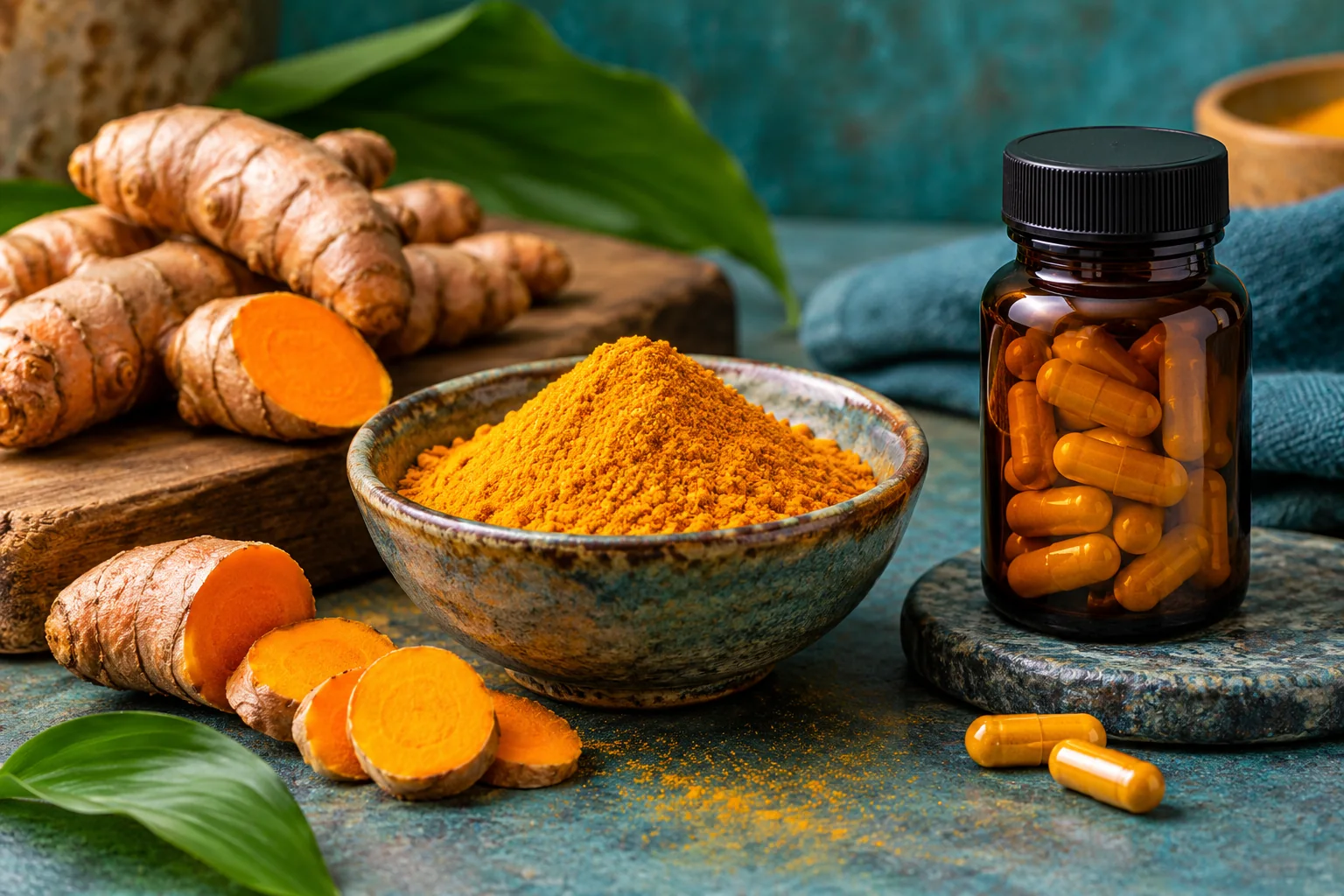
Complementary human studies · Published 2019 & 2022
A golden latte, a curry and a capsule can all contain turmeric. They cannot all borrow the same result from a knee-pain trial. For someone hoping that a familiar ingredient might make stairs easier, that distinction is the starting point.
There is a signal worth studying, with limits worth keeping
Curcumin is one of turmeric's compounds. Researchers have tested preparations designed to concentrate these compounds or alter their absorption. A positive result applies first to that preparation, in the people and period studied—not to every turmeric food, capsule or gummy.
The NIH evidence summary describes the initial osteoarthritis research as positive but says higher-quality evidence is needed for definitive conclusions. That is compatible with cautious interest, rather than a promise to treat any knee ache.
What improved in the Australian trial?
The Perth study found greater improvement in its primary knee-pain questionnaire with the extract than placebo. Both groups improved, so the relevant result is the extra change between groups, not the full improvement seen after taking capsules.
Some walking-related tests also favoured the extract. Other tests, broader daily-function measures and quality-of-life scores did not establish a clear advantage. The results were selective, rather than a uniform transformation across every outcome.
The trial did not assess cartilage repair with imaging. Participants reported a prior medical diagnosis, but the research team did not conduct its own detailed imaging or formal severity classification. Those limits make it especially important not to claim a cure for severe arthritis.
Keep the turmeric claims separate
Cooking spice
Flavouring a meal was not the intervention tested in these trials.
Specific extract
Some short-term pain improvements; formulations differ.
Joint repair
A pain score does not establish cartilage regrowth or stopped progression.
Safety
Short trials do not exclude uncommon harms or medicine interactions.
Why “as good as diclofenac” is too simple
A 2019 Indian study compared a different curcumin preparation with diclofenac for four weeks. Pain improved in both groups, and the reported between-group difference was not statistically significant.
But this was open-label: patients and investigators knew what was taken. It lacked a placebo group and was not designed to establish equivalence by a predefined non-inferiority margin. Failing to detect a difference is not the same as proving two treatments equally effective.
Its participant reporting also needs care. The abstract describes 139 assigned patients; the main results report 149 enrolled and 139 completers analysed. We do not turn that discrepancy into a precise universal success rate. The trial was registered retrospectively, another reason to keep strong claims in check.
These studies from India and Australia broaden the conversation. They used different extracts, comparison groups and measurements, so they are not an experiment showing that nationality changes the effect. Their shared useful lesson is that the preparation and design matter.
Natural is not a safety category
The Indian trial reported fewer short-term adverse effects with curcumin than with diclofenac. That does not settle uncommon harms, longer use or interactions in people excluded from the trial. A small, selected sample followed for weeks cannot establish that a product is safer for everyone.
The NIH guidance notes reports of liver injury with some enhanced-bioavailability preparations and advises discussing herbal products with a clinician when taking medicines. Better absorption is not a guarantee of a better benefit-to-risk balance. Pregnancy and medical conditions also change the decision.
Cooking turmeric for flavour is a different exposure from choosing a concentrated extract for pain. Neither an attractive label nor adding pepper creates a clinically verified home recipe.
What can you take from the research?
There is a plausible short-term pain signal for some extracts, enough to discuss rather than automatically dismiss. There is not enough here to select a product, prescribe a regimen or replace assessment of ongoing knee symptoms.
Ask what was measured, whether the improvement mattered to daily life, and whether it applies to your situation. A treatment plan can address movement, function and other needs that a supplement study does not cover. A pain-score headline is only part of that picture.
Evidence context: Dolcas Biotech funded the Australian trial and participated in study design and manuscript writing; an author was its scientific-affairs director. The Indian authors declared no competing interests. These are educational findings, not medicine-switching advice.
Sources & further reading
- Australia · a particular curcumin extract (2022)
- 2019 Indian curcumin versus diclofenac trial
- NIH turmeric evidence and liver-safety guidance
Study years differ from this article’s publication date. We reviewed full primary papers and relevant supporting material; access limitations are kept out of efficacy claims. Original illustrations and diagrams; no publisher figures reproduced. Educational writing, not clinical review.
Published 11 October 2026 · Sources checked 11 October 2026. Suggest a correction.