 PoshanSense
Less processing, more weight loss? Read the fine print.
The 2025 UPDATE trial found a difference between two diets. Here is the result, the uncertainty and the debate behind it.
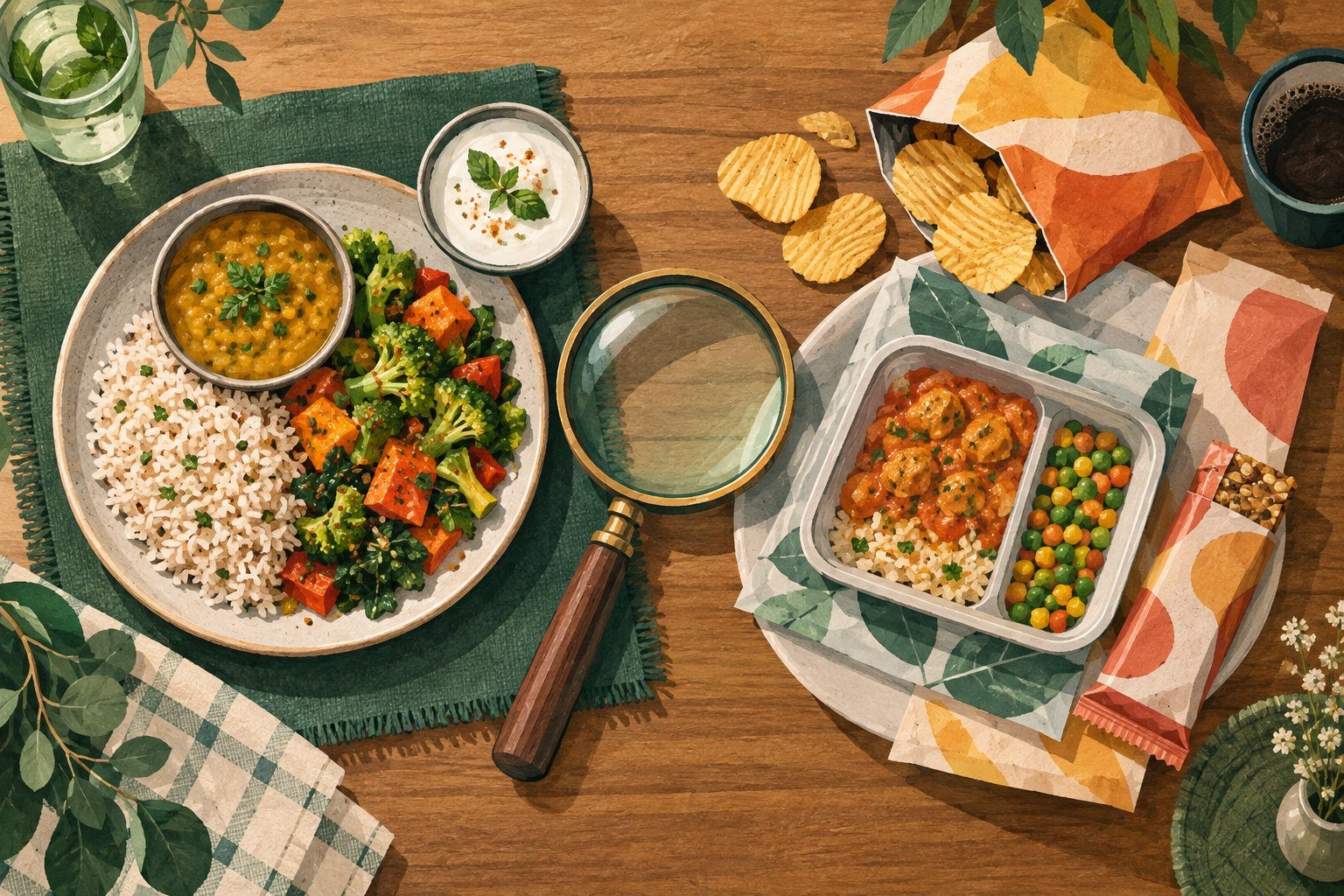
A study result is a clue to understand, not a promise for your body.
“Twice the weight loss” makes a magnificent headline. It also makes a rather wobbly promise for your next eight weeks. A trial published in Nature Medicine in August 2025 compared diets with different levels of processing. Its result is interesting; the details are the part that keeps it useful. Neither your body nor your kitchen signed up to repeat the experiment.
First, what actually happened?
Researchers randomized 55 adults in England to two supplied diets, each lasting eight weeks, with a four-week washout. Both followed the UK Eatwell Guide; one used minimally processed foods and one ultra-processed foods. Fifty people contributed to the primary analysis. Read the open-access paper.
Average weight change was −2.06% on the minimally processed diet and −1.05% on the ultra-processed diet. The within-person difference was −1.01 percentage points (95% confidence interval −1.87 to −0.14). These are changes in body weight, not percentage reductions in calorie intake.
Two diets. One comparison.
The caution belongs beside the result
Most participants were women; all were adults with overweight or obesity and high habitual ultra-processed food intake. Meals were provided. This was not a year-long study of Indian households. Researchers disclosed public and charitable funding, and some authors reported pharmaceutical, consultancy or book-related interests. See the paper’s acknowledgements and declarations.
The journal also published methodological criticism and concerns about the conclusions in January 2026. Critics questioned nutritional differences and extrapolation. The eight-week result should not be sold as a reliable one-year forecast.
Why the headline needs a translator
Imagine two discounts: ₹2 off and ₹1 off. One is twice the other, but the gap is ₹1. A ratio can sound bigger than the difference it describes. Here, looking at the percentage-point difference helps you read the headline without letting it borrow extra drama. The analogy explains the arithmetic; money and weight are obviously different things.
A study average also hides individual experiences. You cannot take the average change, multiply it by your current weight and book that result into your calendar. A confidence interval describes statistical uncertainty in an estimated comparison. It does not list the range of outcomes that every future reader will experience.
What this means for an ordinary Tuesday
Our practical interpretation: compare whole meals before judging a single packet. Picture a rushed lunch of packaged snacks. A workable alternative might be leftover dal, rice and curd, if those are accessible and suit you. That is an example of a meal choice, not a menu tested in this English trial, and certainly not a guarantee of weight loss.
Ask what you would realistically prepare, what it costs and whether you enjoy eating it. A beautifully theoretical lunch that never leaves the fridge is not much of a lunch. Convenience matters, particularly when work, caregiving or limited kitchen access decides what is possible.
Use a journal as a notebook, not a verdict
If you log meals, record what you actually ate and how the portion was measured. You can add a short preparation description rather than trying to diagnose every food from its name. Avoid assigning an entire cuisine a processing label. Roti, dal and ready-made meals can have very different recipes; the details matter more than the mascot on the packet.
The question worth keeping is modest: “Would a small, workable change make my usual meal easier to understand and repeat?” This paper cannot prescribe your personal target. If you need a diet for a health condition or have concerns about eating or weight, get individual advice from a qualified professional.
Sources & further reading
- Dicken et al. (2025), Nature Medicine — full paper, methods, funding and interests
- Published methodological concerns (2026)
- Published concerns about conclusions (2026)
Cover art is AI-generated conceptual illustration; it does not depict actual study meals. Diagrams are original PoshanSense graphics. Paper figures and publisher images are not reproduced. Examples and practical interpretations are identified in the text.
Published 5 October 2026 · Sources checked 5 October 2026. Suggest a correction.