 PoshanSense
Can an air purifier lower blood pressure—or just the pollution?
A Shanghai trial found short-term blood-pressure changes after filtration. Why reducing particles is different from treating hypertension or preventing heart attacks.
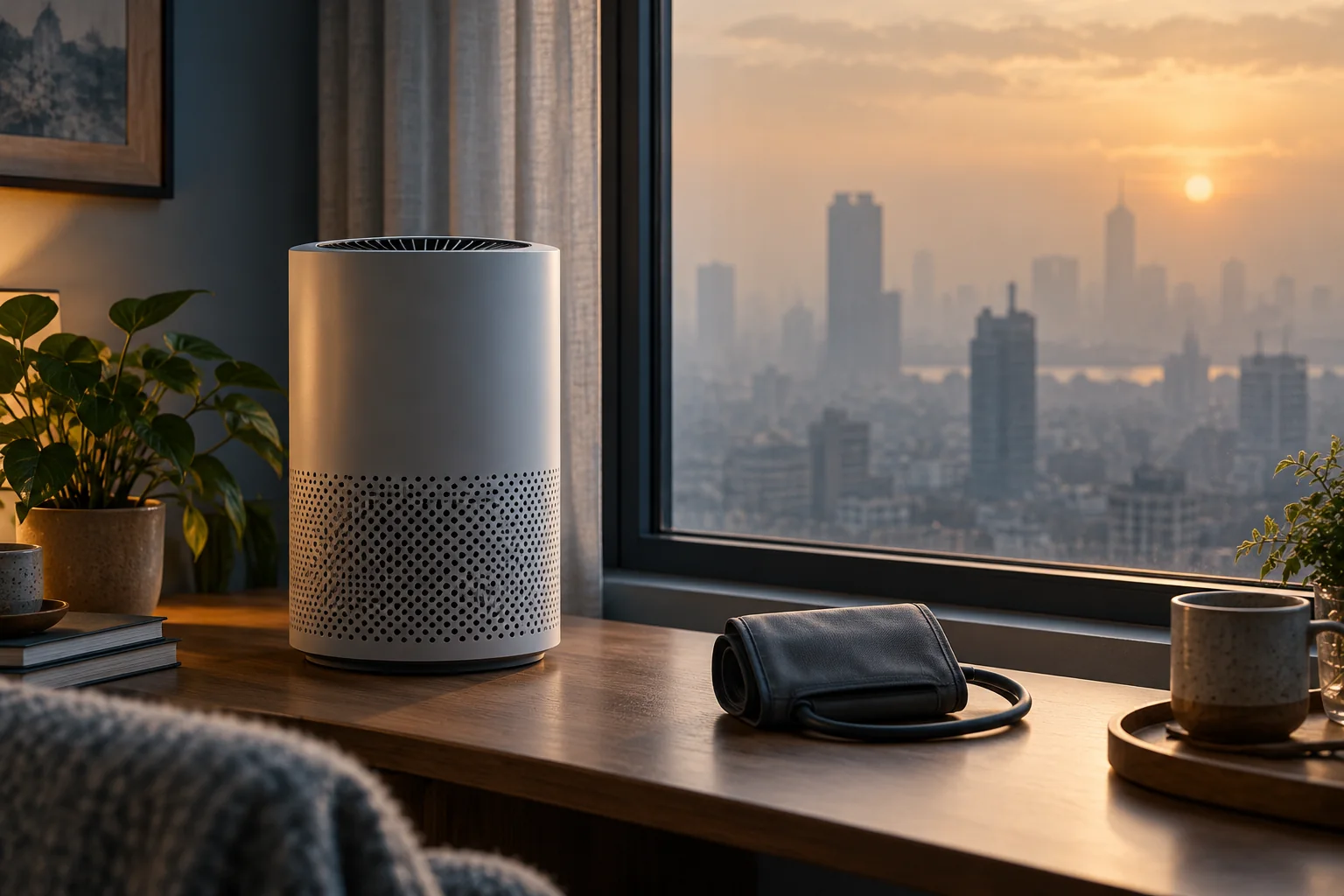
Research explained · Published 2015
When outdoor air is hazy, a purifier can feel like a practical step. Then an advertisement makes the leap from “less dust in the room” to “better heart health.” How much of that leap is supported?
Does lower pollution automatically mean lower blood pressure?
Not automatically for every person or every room. Reducing particle exposure is the direct task of a particle filter. A blood-pressure benefit is a separate outcome influenced by the setting, the person, the time period and other care.
The Shanghai experiment provides a useful reason to investigate that connection. It does not turn a purifier into an antihypertensive treatment, or establish that cleaner-looking air always means a measurable change in blood pressure.
What did the filter actually change?
In the 2015 trial, average fine-particle concentration was about 57% lower with functioning filters than with sham devices: roughly 41 versus 96 micrograms per cubic metre. The sham machines looked like the active machines but had their filters removed.
Students stayed mostly inside, with doors and windows closed, and meals were delivered. This helped control competing exposures, but it is quite different from normal homes with cooking, commuting, variable window opening or tobacco smoke.
What happened to blood pressure?
After filtration, the researchers estimated a 2.7% lower geometric mean systolic pressure and a 4.8% lower diastolic pressure relative to sham. These are percentages in an analysis of skewed measurements—not reductions of 2.7 or 4.8 mmHg.
Some blood and airway-inflammation markers also changed, while lung-function differences were not clear. Many outcomes were examined in only 35 people, and blood pressure was a secondary outcome. The authors described the study as exploratory.
No one was followed to determine whether filtration prevented a heart attack, stroke or death. A short-term change in a marker cannot simply be renamed a proven reduction in those events.
Separate the exposure from the claim
Direct target
Filters reduce some airborne particles.
Trial result
Short-term blood-pressure differences in healthy students.
Not established
Hypertension treatment or fewer heart attacks.
Whole setting
Sources, ventilation and filtration address different needs.
Would this work the same in another country?
The general question is relevant wherever outdoor particles enter buildings. The exact result is not automatically transferable from Shanghai student dormitories to a low-pollution European home, a busy Indian kitchen or someone with treated hypertension.
Initial pollution levels, indoor sources and the time spent in the filtered space may differ. A result in healthy young adults also cannot establish the same benefit or safety conclusions for every clinical group.
What else matters besides a filter?
The US Environmental Protection Agency treats filtration as a supplement to controlling pollutant sources and ventilating with clean outdoor air. It also notes that air cleaners cannot remove every pollutant. A particle result does not mean all gases or every indoor-air problem has been solved.
The study’s instruction to close windows was part of an experiment, not a universal ventilation rule. Choosing how to manage a real building requires considering the sources and outdoor conditions, rather than copying one research weekend.
What should you take away?
Cleaner particle exposure is a reasonable environmental objective. Keep that separate from promises about your personal blood pressure. Continue appropriate monitoring and medical care; do not reduce medication because a purifier is running.
The study had Chinese public and foundation support, with an author supported by the US NIH intramural programme. Authors reported no relevant relationships to disclose. Educational article; not clinically reviewed. The direct particle result is stronger than any claim of long-term heart protection.
Sources & further reading
Study years differ from this article’s publication date. We reviewed full primary papers and relevant supporting material; access limitations are kept out of efficacy claims. Original illustrations and diagrams; no publisher figures reproduced. Educational writing, not clinical review.
Published 11 October 2026 · Sources checked 11 October 2026. Suggest a correction.