 PoshanSense
Does beetroot juice lower blood pressure? Promising, but not a replacement for care
A four-week UK trial found lower blood pressure with nitrate-rich beetroot juice. Learn what it measured, why other results differ and why juice is not a medication substitute.
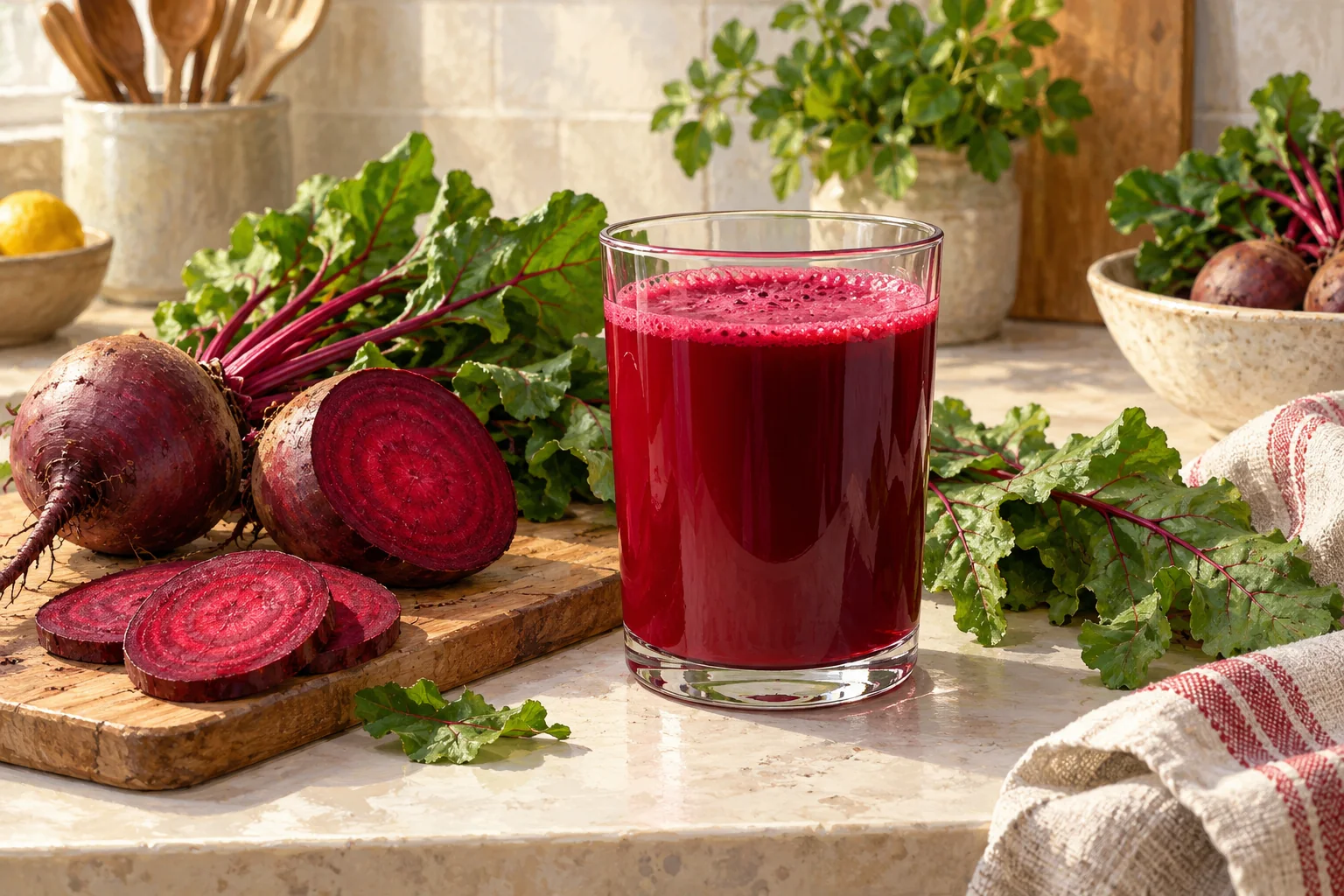
Research explained · Published 2013 · 2015
A glass of beetroot juice sounds like a simpler answer to blood pressure than another appointment. The evidence supports curiosity about the drink, but it does not support abandoning that appointment. The useful question is how much the trial tells us about an ordinary person and an ordinary bottle of juice.
What did the strongest trial show?
In a UK randomized trial, adults with hypertension drank nitrate-rich beetroot juice or a matching juice from which nitrate had been removed. People taking blood-pressure medicines continued their treatment.
The nitrate-rich group saw reductions across clinic, home and 24-hour measurements, while the comparison group did not show the same change. The active group's 24-hour systolic pressure fell by about 8 mmHg from its own starting value. That is a group average in a trial, not a prediction for someone buying juice tomorrow.
Why nitrate matters more than the colour
The proposed pathway starts with dietary nitrate. Bacteria in the mouth help convert it to nitrite, which can contribute to nitric oxide production in the body. Nitric oxide helps blood vessels relax. The trial measured changes consistent with this pathway.
This is why the control drink is revealing: both groups received beetroot juice, but nitrate differed. It is more informative than assuming that anything red and earthy must have the same effect.
Different varieties, growing conditions and processing can change nitrate content. A homemade drink, a concentrated shot, a whole beetroot and the study product are not automatically equivalent. The experiment does not supply a universal serving rule for all of them.
Four questions behind the beetroot headline
What changed?
Blood pressure fell during the nitrate-rich intervention.
Compared with?
Beetroot juice with nitrate removed, rather than no drink.
How long?
Four weeks; pressure began returning after the juice stopped.
What is unknown?
Long-term clinical outcomes and effects of other products.
Other experiments make the answer less certain
An Australian crossover experiment tested a single beetroot-and-apple drink in 30 adults living normally between measurements. The overall six-hour systolic result did not reach conventional statistical significance, and average awake and asleep pressures did not clearly differ.
Some male-only analyses were more favourable, including an analysis excluding two unusual responses. Those results should not be presented as proof that everyone benefited. They also came from a different population, drink and duration than the UK hypertension trial.
A positive four-week study and an uncertain single-drink study can both be genuine. Starting blood pressure, product composition and the measurement schedule help explain why one headline cannot stand in for every experiment.
A lower reading is not yet a prevented stroke
The UK trial was not long enough or large enough to establish fewer heart attacks or strokes. After the juice stopped, pressure began moving back towards starting values. We therefore cannot assume a permanent benefit from a brief course.
Its participants were selected: people with certain cardiovascular conditions or impaired kidney function were excluded. The result cannot decide whether juice is appropriate for every patient. The paper also raises oxalate-related considerations for people susceptible to some kidney stones.
What should a reader take away?
Beetroot can be an ordinary food rather than a product with a guaranteed therapeutic promise. If you have hypertension, discuss dietary changes alongside the plan already in place; do not stop medicines or use a reassuring single reading to dismiss follow-up.
Our beetroot-and-exercise explainer covers a different outcome. Better exercise performance and lower blood pressure are not interchangeable claims, even when both studies use nitrate-rich drinks.
The practical answer is promising and bounded: one well-designed small trial found a short-term blood-pressure effect. Product differences, patient differences and missing long-term outcomes still matter.
Evidence context: the UK trial was funded by the British Heart Foundation; one author was a director of Heartbeet Ltd. The Australian study received juice-industry funding and product support. Educational information; not clinically reviewed.
Sources & further reading
Study years differ from this article’s publication date. We reviewed full primary papers and relevant supporting material; access limitations are kept out of efficacy claims. Original illustrations and diagrams; no publisher figures reproduced. Educational writing, not clinical review.
Published 11 October 2026 · Sources checked 11 October 2026. Suggest a correction.