 PoshanSense
Can nuts lower cholesterol—and does the portion matter?
Walnuts and other tree nuts can modestly improve LDL cholesterol in trials. The useful question is how they fit your usual meals, not which nut deserves a miracle label.
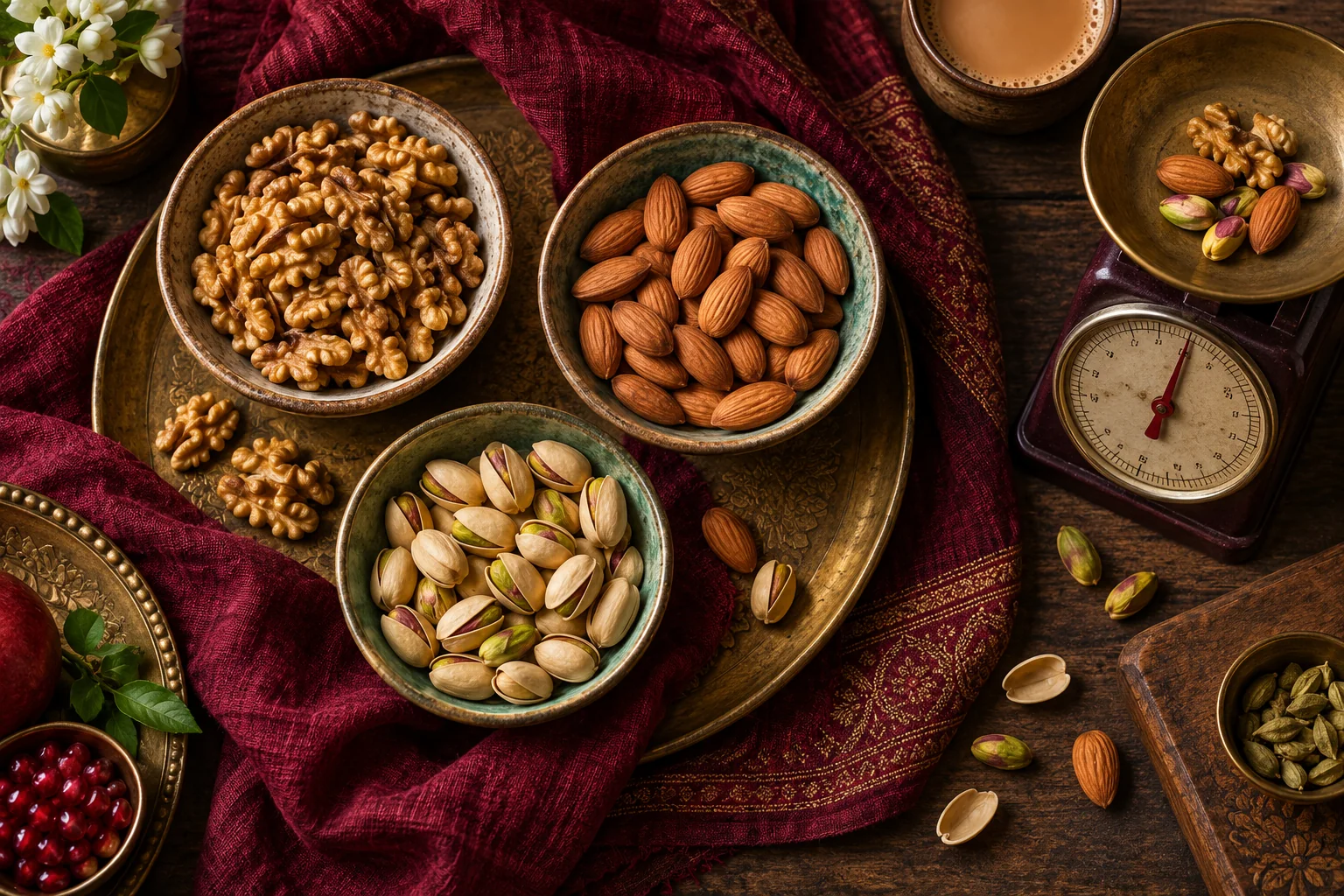
Complementary human studies · Published 2015 & 2026
The cupboard has almonds, walnuts and a bag of cashews. An online ranking insists only one is the “heart-healthy” choice. Before turning breakfast into a competition between nuts, it helps to ask a more useful question: do nut-containing diets change cholesterol, and by how much?
Yes, but think modest improvement
The 2026 walnut review found an average LDL difference of about 5.7 mg/dL in favour of walnut-containing diets, with a 95% confidence interval of roughly 3.5–7.9 mg/dL lower. That is a measured average across trials, not a guaranteed change after buying a packet.
HDL did not show a clear overall improvement. Nor did the review establish that walnuts prevented heart attacks in its pooled experiments. A blood marker is useful evidence, but it answers a narrower question than a clinical outcome.
Are walnuts better than almonds?
A 2015 review of 61 controlled tree-nut trials also found modest LDL reductions. Its analysis did not establish a statistically convincing difference by nut type. This supports the general direction without proving that all nuts are identical or that one particular handful is optimal.
The older review included both randomised and nonrandomised studies. The newer one focuses on walnuts, and some research overlaps. We therefore do not add their participant counts or treat them as two entirely separate confirmations.
For a reader choosing between affordable nuts, the evidence does not justify a costly “best nut” upgrade. Preference, allergies, availability and the way a food fits an ordinary week remain relevant. The pooled finding also should not be copied to nut oils or every nut-flavoured product.
The question is bigger than the handful
Food
Which nuts actually fit your taste, budget and dietary needs?
Portion
A measured serving and repeated uncounted handfuls are different routines.
Replacement
A snack swap and an extra snack change the whole diet differently.
Outcome
A change in LDL is not a demonstrated reduction in clinical events in these trials.
Why the portion question matters
It is easy to remember the handful at breakfast and forget several more while working. A dietary trial usually records what people receive or report eating. An open packet on the desk is much less defined.
That distinction is not a reason to fear nuts. It is a reason to describe your actual routine accurately. “I started eating walnuts” could mean replacing another snack, adding a topping, or adding a substantial extra snack. Those changes need not have the same effect on the rest of the diet.
Try thinking in meals rather than isolated ingredients: what did you usually eat at that time, what changed, and did anything else change with it? This makes both a food journal and a research headline easier to interpret. The studies do not establish a universal handful size for your circumstances.
Keep the rest of the plate in view
A nut-containing breakfast does not make every other food choice irrelevant. The WHO’s broader healthy-diet guidance places nuts within a varied pattern; it does not present them as a treatment on their own. The same principle works with oats and nuts in the US, a European breakfast, or a familiar Indian snack routine.
Country labels alone are not enough to explain who benefits. The trials differ in participants, baseline lipids, foods and follow-up. The walnut review also notes that many comparison diets were poorly described. That limits how precisely we can translate its average into a particular kitchen.
The useful takeaway
Nuts can be part of a sensible food pattern, and their LDL evidence deserves more than a decorative “superfood” claim. Keep the effect in proportion, avoid ranking products beyond the data, and remember the snack being replaced. If you already have high cholesterol or prescribed treatment, this article does not provide a substitute plan or a reason to change medication.
Evidence context: the 2026 review reports no specific grant and no conflicts of interest; its protocol was not prospectively registered. The older review reports public funding and tree-nut industry involvement/disclosures. Those details accompany the results rather than settle them.
Sources & further reading
- International trials · walnut review (2026)
- 2015 review: 61 controlled tree-nut trials
- WHO: varied diets and fat quality
Study years differ from this article’s publication date. We reviewed full primary papers and relevant supporting material; access limitations are kept out of efficacy claims. Original illustrations and diagrams; no publisher figures reproduced. Educational writing, not clinical review.
Published 11 October 2026 · Sources checked 11 October 2026. Suggest a correction.