 PoshanSense
Is dark chocolate good for your heart—or is that a cocoa-extract headline?
A large cocoa trial tested capsules, not chocolate bars. Understand the difference between a promising secondary finding and a proven daily-chocolate prescription.
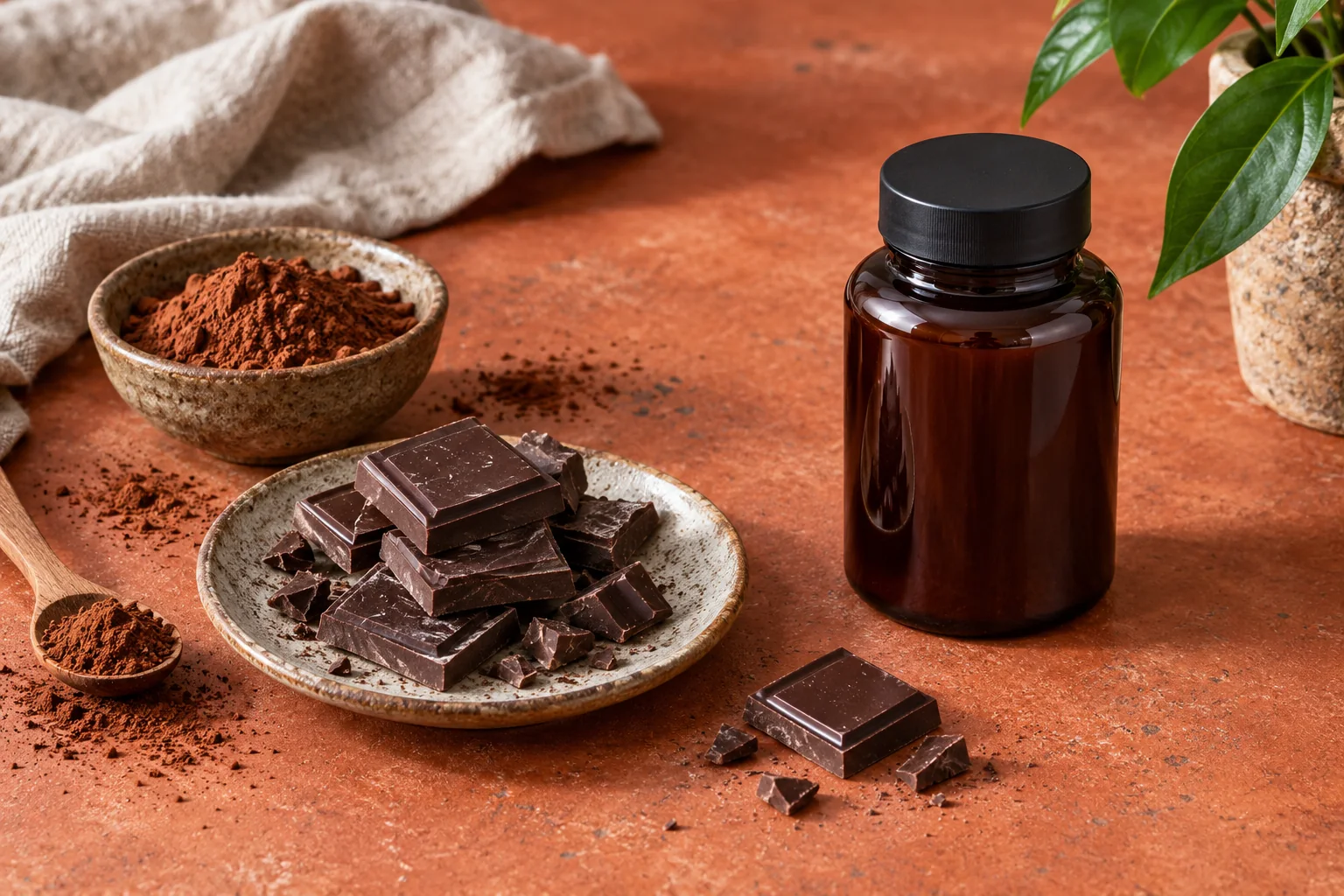
Complementary human studies · Published 2015 & 2022
A headline about cocoa can become a chocolate-shopping tip remarkably quickly. The leap feels natural: chocolate contains cocoa, so surely a successful cocoa study tells us what to eat? The details change that answer.
Chocolate and an extract are not interchangeable
The major trial here supplied capsules containing a defined amount of cocoa flavanols. It did not ask participants to eat a particular dark-chocolate bar. A food's name, cocoa percentage and packet photograph do not establish that it matches the intervention.
This is not a reason to feel guilty about enjoying chocolate. It is a reason to separate enjoyment from a claim that a retail product prevents heart disease. The second claim requires much more specific evidence.
What happened in the large trial?
The COSMOS primary report counted 410 participants with its primary cardiovascular outcome in the cocoa group and 456 in the placebo group. The hazard ratio was 0.90, with a 95% confidence interval from 0.78 to 1.02. The result was not statistically significant.
That is compatible with several possibilities, including some benefit and no clear benefit. It should not be rewritten as a proven ten-percent reduction. A point estimate without its uncertainty can make an inconclusive comparison sound settled.
Cardiovascular death was lower in the cocoa group, a favourable secondary result. The study examined many outcomes without adjusting those comparisons for multiple testing. The authors therefore describe secondary and exploratory findings cautiously. The most encouraging number is not automatically the strongest answer.
Three steps a chocolate headline can skip
What was supplied?
A defined cocoa-extract capsule, not a chocolate bar.
What was primary?
Total cardiovascular events did not significantly fall.
What was promising?
Cardiovascular death was a favourable secondary finding.
What follows?
More research, not a universal daily chocolate prescription.
Why does the primary outcome matter?
Researchers specify a main question so that a trial is not judged solely by whichever result looks most exciting afterwards. COSMOS used a broad combination of cardiovascular events, and the report explains that the definition was expanded as event rates were lower than expected.
Its original composite also had a similar overall estimate. This makes the paper more nuanced than a simple positive-or-negative stamp, but it does not justify ignoring the primary result. A later or secondary analysis contributes information with additional uncertainty.
The same principle helps with other nutrition headlines. Ask what the experiment was principally designed to test before treating a subgroup, laboratory marker or secondary outcome as its verdict.
What about people who eat chocolate?
A UK EPIC-Norfolk analysis followed 20,951 adults and found associations between chocolate intake and some cardiovascular outcomes. It also explicitly recognised remaining confounding. People who report eating different amounts of chocolate can differ in other ways.
That was observational evidence, not an assigned chocolate-bar experiment. It cannot tell you that starting a particular brand will produce the same association, or that eating more is better. It also cannot turn the capsule trial into a test of ordinary confectionery.
The two studies are useful together because they show different evidence routes: habitual food intake in a British population and an assigned extract in older US adults. They should not be blended into one unconditional promise.
Does a higher cocoa percentage solve the problem?
No percentage on its own reproduces the capsule intervention. Processing changes cocoa compounds, and a bar also supplies other ingredients and energy. The paper discusses that variability as a reason to study a defined extract.
Nor does the trial establish a safe conversion from capsules to squares. Estimating a supposedly therapeutic serving from a retail packet would go beyond what was tested. A product can have a high cocoa percentage without being a standardized research preparation.
A practical answer without the health halo
If you enjoy chocolate, consider the portion and how it fits your usual food routine. You do not need to defend the choice with a treatment claim. Likewise, you do not need to start taking a cocoa supplement because one secondary endpoint made an attractive headline.
Heart-health decisions belong in a broader picture that includes individual risk and appropriate care. This article does not replace that assessment or identify a supplement dose for you. The trial used eligibility rules and follow-up, not a general instruction for every reader.
Across countries, products and eating habits vary. The reliable distinction stays the same: a food containing an ingredient is not automatically the intervention, and a promising secondary result is not a guaranteed benefit. That is the useful answer to carry past the headline.
Evidence context: COSMOS had Mars Edge grant support and supplied trial materials, alongside NIH support. Two investigators disclosed relevant grants and other relationships. Companies reportedly did not direct design, analysis or manuscript preparation.
Sources & further reading
Study years differ from this article’s publication date. We reviewed full primary papers and relevant supporting material; access limitations are kept out of efficacy claims. Original illustrations and diagrams; no publisher figures reproduced. Educational writing, not clinical review.
Published 11 October 2026 · Sources checked 11 October 2026. Suggest a correction.