 PoshanSense
Does eating while distracted make you eat more?
Distraction can change meal memory, but not every task increases intake. A US crossover experiment explains why screen-time and food claims need context.
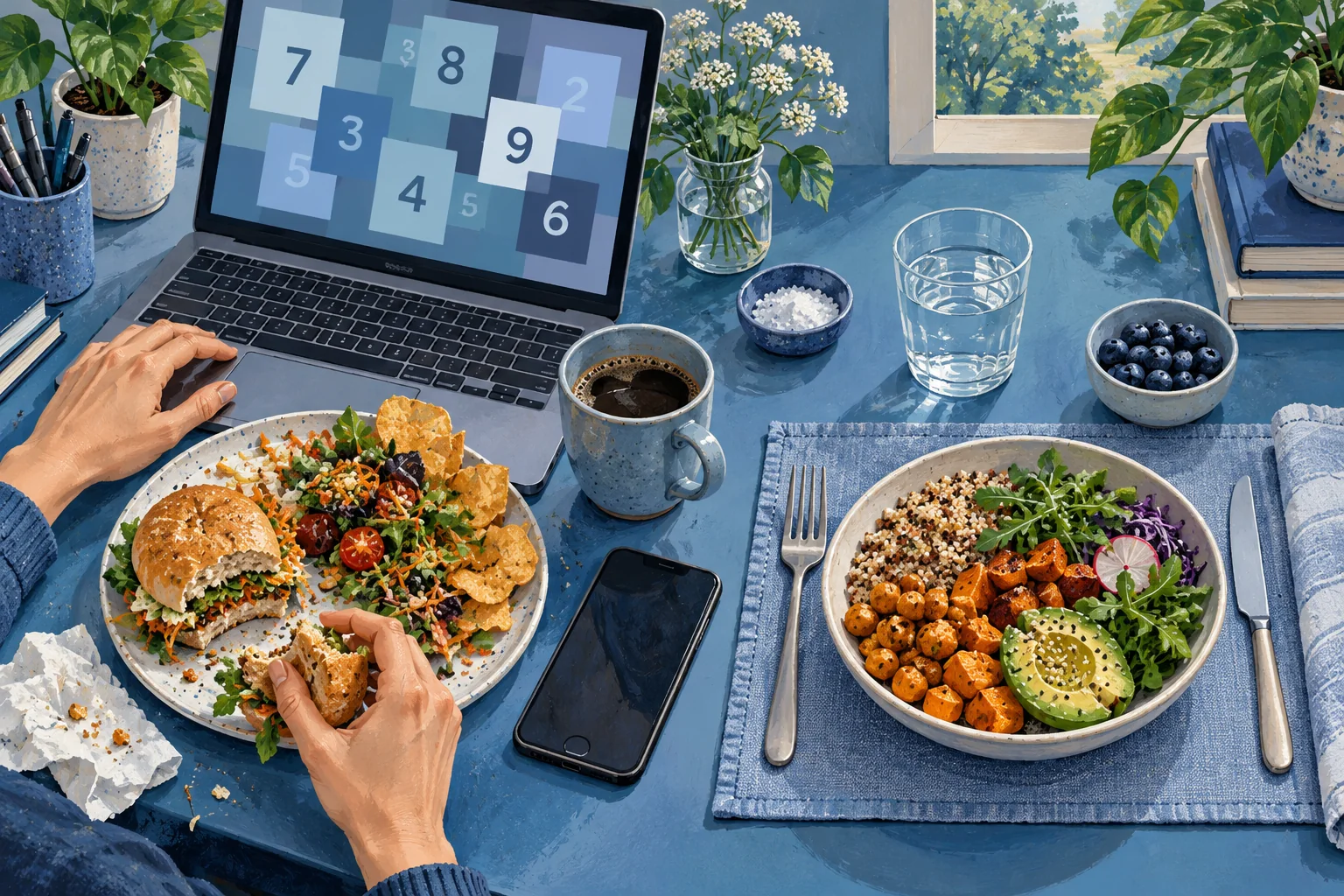
Research explained · Published 2020
You finish lunch at your laptop and barely remember eating it. Does that mean you necessarily ate too much—or that the next snack will be larger? Research makes the first observation plausible while leaving the second less predictable.
Attention matters, but the direction is not automatic
A US experiment asked people to eat quiche while completing a demanding number-monitoring task. They ate less quiche on average than without the task, but remembered the meal less accurately.
There was no clear difference in the grapes or cookies eaten thirty minutes later. The study therefore supports a change in attention and meal memory without supporting the simpler claim that distraction always increases intake.
Why might a demanding task reduce the meal?
The researchers noted that the food was relatively unfamiliar and that the effect depended strongly on which condition came first. Participants distracted during their first exposure ate particularly little. Those patterns make a general conclusion about screens difficult.
A task that competes with eating may interrupt bites. An entertaining programme with a bowl within easy reach creates a different situation. The explanation is a hypothesis about context; this trial did not measure every ordinary activity or identify a universal mechanism.
Distraction did not produce one uniform effect
During the task
Less quiche was consumed on average.
Meal memory
Recall of the amount received and eaten was less accurate.
Later snack
No clear difference in grape or cookie intake.
Translation
A timed number task is not every kind of screen use.
Remembering lunch is not the same as feeling full
The participants’ meal-memory responses became less accurate with distraction, while reported hunger and fullness did not clearly differ overall. Those are separate measurements, and it is useful not to collapse them into a single “appetite” result.
You may remember a meal poorly without immediately feeling hungrier. Conversely, knowing what you ate is not a perfect measure of how much nourishment you need. Attention is one part of eating rather than an infallible internal calculator.
A practical experiment without a promise
If desk meals feel rushed or disappear without notice, try making one meal easier to attend to: pause demanding work, put the serving where you can see it and allow time to eat. The aim can be enjoying and noticing lunch, rather than engineering a smaller intake.
Some people find company or background entertainment helpful. The research does not justify turning every social meal into silence. Nor should it make someone feel guilty about eating during a busy workday or while managing caring responsibilities.
Keep food access and the whole day visible
A timed laboratory meal cannot tell us what happens when a person later has dinner, gets hungry during a shift or has unrestricted snacks available. It measured a short window in young adults, not weeks of weight change.
Substantial attrition also matters: the analysed volunteers may differ from those who did not complete both sessions. The results are informative about this experimental setting, rather than a personal forecast for every age and lifestyle.
Answer the real question
If the question is “Can distraction affect eating?”, yes: this study showed that it can alter intake and memory. If the question is “Will putting away my phone make me lose weight?”, this evidence does not settle it.
A useful habit should earn its place through a more manageable, satisfying eating experience. Treat attention as something to explore, and leave the guaranteed calorie effect out of the story.
Evidence context: the authors reported no financial support and no conflicts. Educational information; not clinically reviewed.
Sources & further reading
Study years differ from this article’s publication date. We reviewed full primary papers and relevant supporting material; access limitations are kept out of efficacy claims. Original illustrations and diagrams; no publisher figures reproduced. Educational writing, not clinical review.
Published 11 October 2026 · Sources checked 11 October 2026. Suggest a correction.