 PoshanSense
Can an eye mask help you sleep or remember more the next day?
A UK home-sleep experiment found small learning benefits, but not longer sleep or more deep sleep. The room and outcome matter.
Research explained · Published 2023
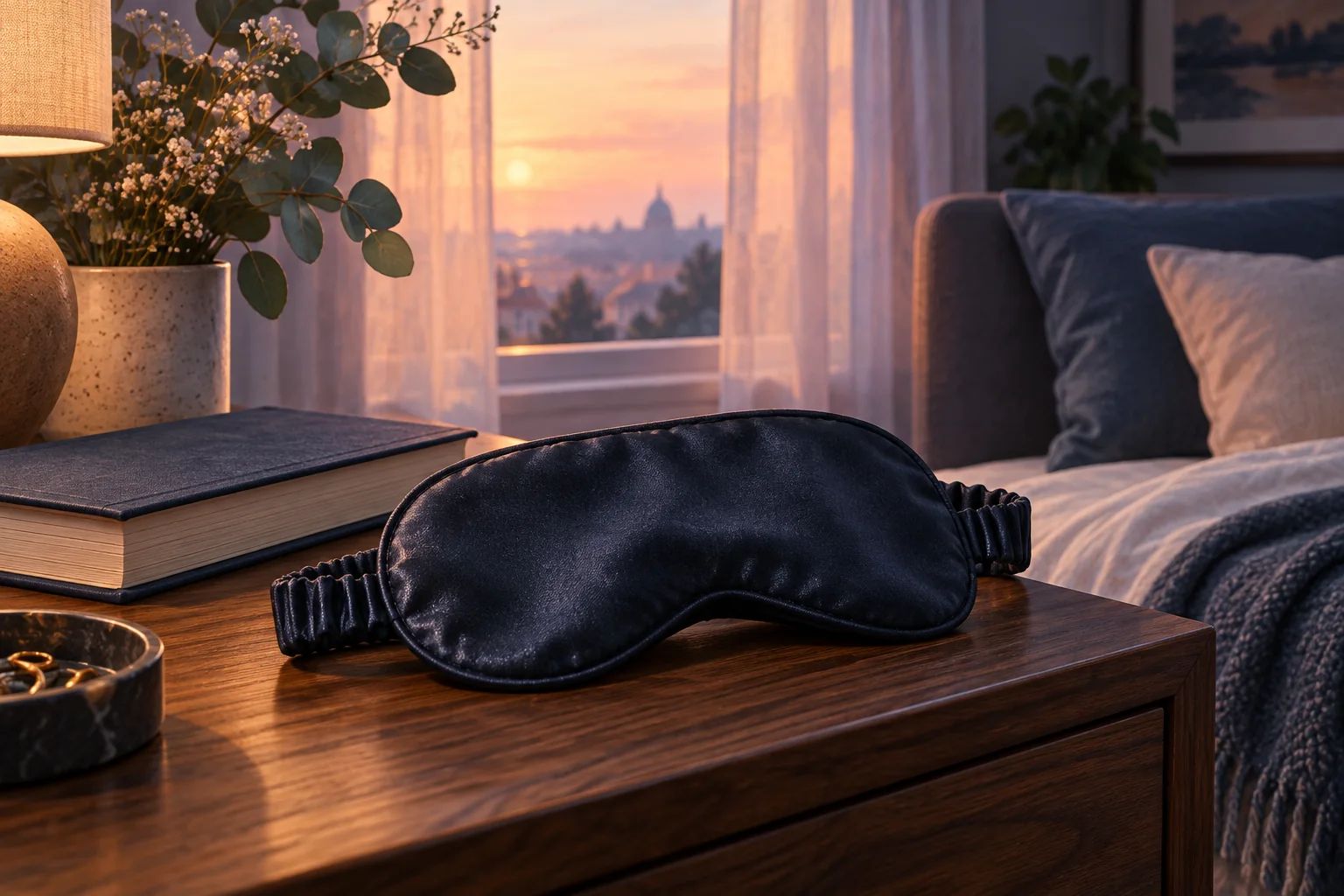
Some sleep accessories promise a complicated upgrade. An eye mask has a simpler job: keep light out of your eyes. That can be attractive when dawn arrives early or another person needs a lamp. Whether it also improves memory is a separate question.
Would it help in an already-dark room?
The main experiment cannot answer that directly. Participants were asked to leave their curtains or shutters open, and testing took place during summer. An eye mask in that setting changes light exposure more than it might in a room with effective blackout curtains.
The comparison also matters. Early participants wore no mask in the control condition; later participants wore a modified mask with holes over their eyes. Those conditions help explore the effect of blocking light, but are not identical experiences.
What improved the next morning?
In the Cardiff study, participants learned slightly more word pairs after wearing the light-blocking mask. The average effect was small. The first experiment also found somewhat faster responses on a vigilance task.
Motor-sequence learning did not clearly improve, and the second experiment did not reproduce every attention result. The finding therefore does not justify saying masks enhance all forms of memory, concentration or performance.
A laboratory task is useful because it can measure a specific ability consistently. It is also narrower than an exam score, a productive workday or safe driving. None of those real-world outcomes was tested.
Did people sleep longer or more deeply?
Reported sleep hours did not clearly differ between conditions. The smaller experiment did not find a clear increase in time spent in any sleep stage, and self-rated sleep quality was not clearly better.
Among people wearing the mask, more slow-wave sleep was associated with better learning. That correlation does not show that the mask increased deep sleep or that deep sleep caused the observed learning difference.
The researchers proposed possible explanations, including changes their wearable could not measure. Those ideas remain hypotheses. A claim that the mask “boosts deep sleep” would skip an important boundary in the results.
What the eye mask changed
Bedroom light
The mask blocked light while curtains remained open.
New learning
Word-pair learning improved slightly.
Sleep amount
Reported hours and sleep-stage totals did not clearly improve.
Real life
Better exams or safer driving were not tested.
How relevant is this beyond the UK?
Unwanted bedroom light is not unique to one country. Early sunrise, shared rooms and artificial lighting can occur anywhere. But the size of any benefit may depend on the light, the room and the person.
The volunteers were healthy adults aged 18–35, screened to exclude sleep disorders and certain sensitivities. The experiment does not establish treatment for insomnia, effects in older adults or the best design of mask for every sleeper.
Keep the expectation simple
If the practical problem is unwanted light, judge a mask by comfort and whether it solves that problem. It need not be sold as a cognitive enhancement device. If your room is already dark, this research cannot promise an extra benefit.
Persistent sleep difficulty requires a different question from choosing an accessory. A mask is not an assessment of breathing problems or an alternative to evidence-based insomnia care.
The work was supported by a European Research Council grant; the authors declared no financial or non-financial conflicts. Educational article; not clinically reviewed.
Sources & further reading
Study years differ from this article’s publication date. We reviewed full primary papers and relevant supporting material; access limitations are kept out of efficacy claims. Original illustrations and diagrams; no publisher figures reproduced. Educational writing, not clinical review.
Published 11 October 2026 · Sources checked 11 October 2026. Suggest a correction.