 PoshanSense
Are fermented foods the same as probiotics?
Dahi, kimchi and fermented batters do not all make the same probiotic claim. Understand the difference between fermentation, live cultures and demonstrated benefit.
Complementary human studies · Published 2021
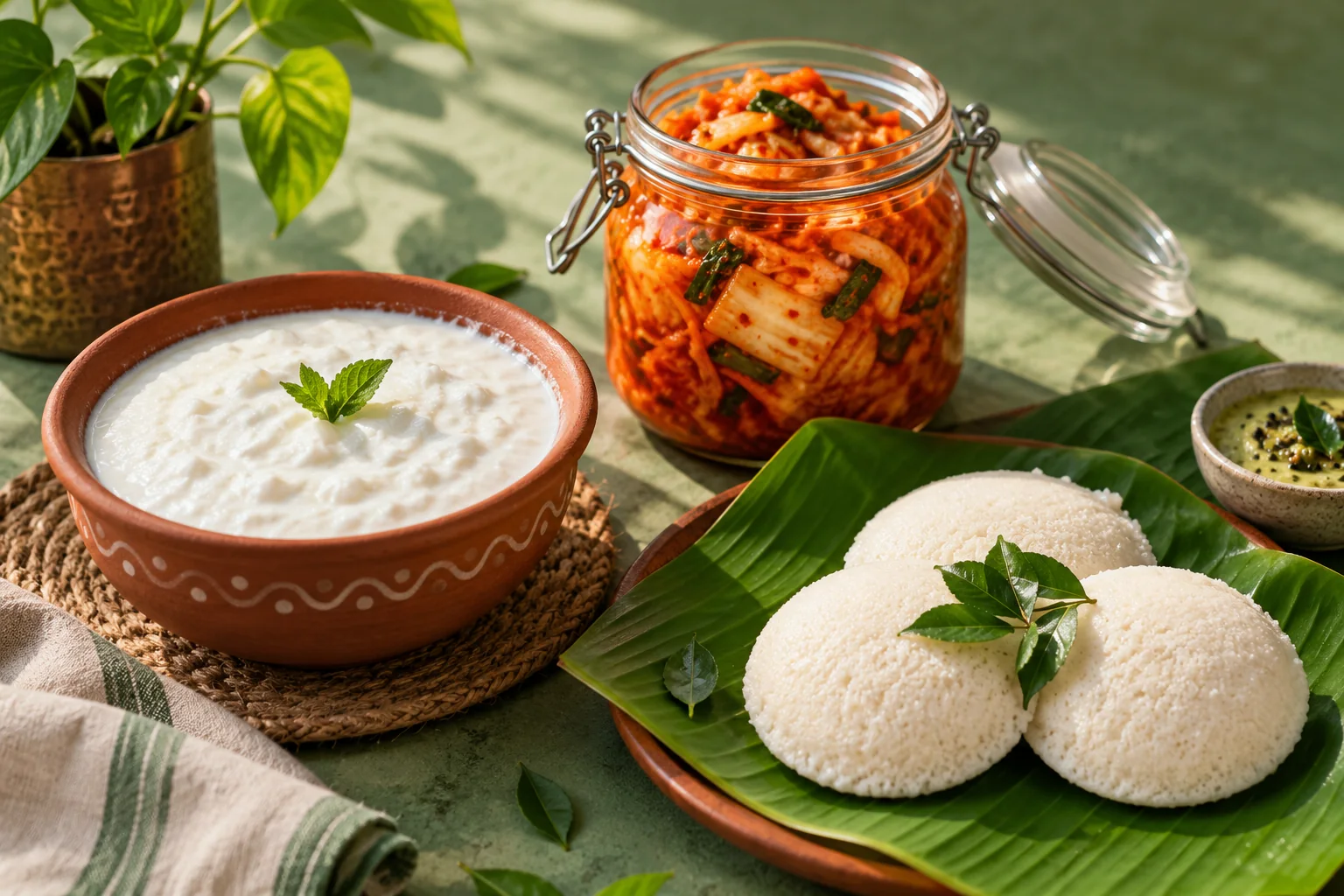
Dahi, kimchi, kombucha and an idli batter all involve fermentation. That does not mean they deliver an interchangeable probiotic treatment. The easiest way to make sense of the labels is to ask three separate questions: how was the food made, what is alive when you eat it, and what benefit has actually been demonstrated?
Fermented describes the process
The 2021 ISAPP consensus separates fermented foods from probiotics. Fermentation involves desired microbial activity that changes food. The finished food may still contain live microorganisms—or processing and cooking may have removed or killed them.
This is why a fermented batter and its cooked dish are not the same live-culture product. Bread remains a fermented food even after baking. Likewise, a pasteurized fermented drink can honestly have been fermented without containing the live organisms that a customer imagines.
“Contains live cultures” is another claim. “Probiotic” goes further: the microorganisms need to be appropriately identified and supported by evidence of a health benefit. The consensus is useful terminology guidance, not a trial showing that every fermented food improves health.
Does eating fermented food change the gut?
In the California dietary study, the fermented-food group showed increased microbial diversity and changes in several inflammatory measurements. That is interesting human evidence, rather than just a laboratory experiment on a food sample.
But the main cytokine-response outcome did not change. Many other measurements were exploratory. The study did not establish less disease, longer life or a guaranteed improvement in digestive symptoms. More diversity is a research observation here, not a universal score that every gut needs to maximize.
Three overlapping labels
Fermented
Describes microbial changes during food production.
Live cultures
Describes organisms remaining at consumption.
Probiotic
Adds identification and evidence for a relevant benefit.
Does that mean fibre lost the competition?
No. The high-fibre group showed changes in microbial functions without the same diversity change. That illustrates a useful point: the microbiome has many measurable properties. Judging two diets using a single fashionable measurement can miss other changes.
There was also no ordinary-diet control group. The study compared two active dietary approaches in a small, selected group of healthy adults. Its participants and mixed fermented foods do not represent every population or prove the effect of one serving of Indian dahi.
Nor should its research diet become a daily serving prescription. A structured intervention, participant selection and repeated laboratory measurements are not equivalent to choosing a supermarket product while continuing your usual routine.
How to read a product without buying the hype
Ask whether the product says it is fermented, contains live cultures or makes a specific probiotic claim. Those statements answer different questions. If a health benefit is advertised, the useful evidence concerns the relevant organisms, product and outcome—not just the word “gut.”
Then return to ordinary food details. Added sugar, sodium, portion size and what the food replaces still matter. A fermented label does not cancel the rest of a nutrition label. A food can also be enjoyable and useful without needing an elaborate microbiome story.
This article is not a guide to homemade fermentation safety or a recommendation to use foods instead of treatment. Persistent digestive problems deserve proper assessment. The Californian study involved generally healthy adults and cannot supply clinical advice for someone with a diagnosed condition.
The answer to remember
Fermentation, live cultures and probiotics overlap, but are not synonyms. Research suggests fermented-food diets can change some biological measurements; it has not proved that every fermented product delivers the same benefit. Let the food be food, and ask for specific evidence when a label promises more.
Sources & further reading
- Gut microbiota-targeted diets and immune measurements
- ISAPP consensus on fermented foods and probiotic terminology
Study years differ from this article’s publication date. We reviewed full primary papers and relevant supporting material; access limitations are kept out of efficacy claims. Original illustrations and diagrams; no publisher figures reproduced. Educational writing, not clinical review.
Published 11 October 2026 · Sources checked 11 October 2026. Suggest a correction.