 PoshanSense
Are frozen vegetables as nutritious as fresh ones?
Often, yes—for the nutrients tested. The useful comparison is fresh food you eat promptly versus food stored for days, not a simple fresh-good, frozen-bad label.
US laboratory food analysis and global guidance · Published 2017
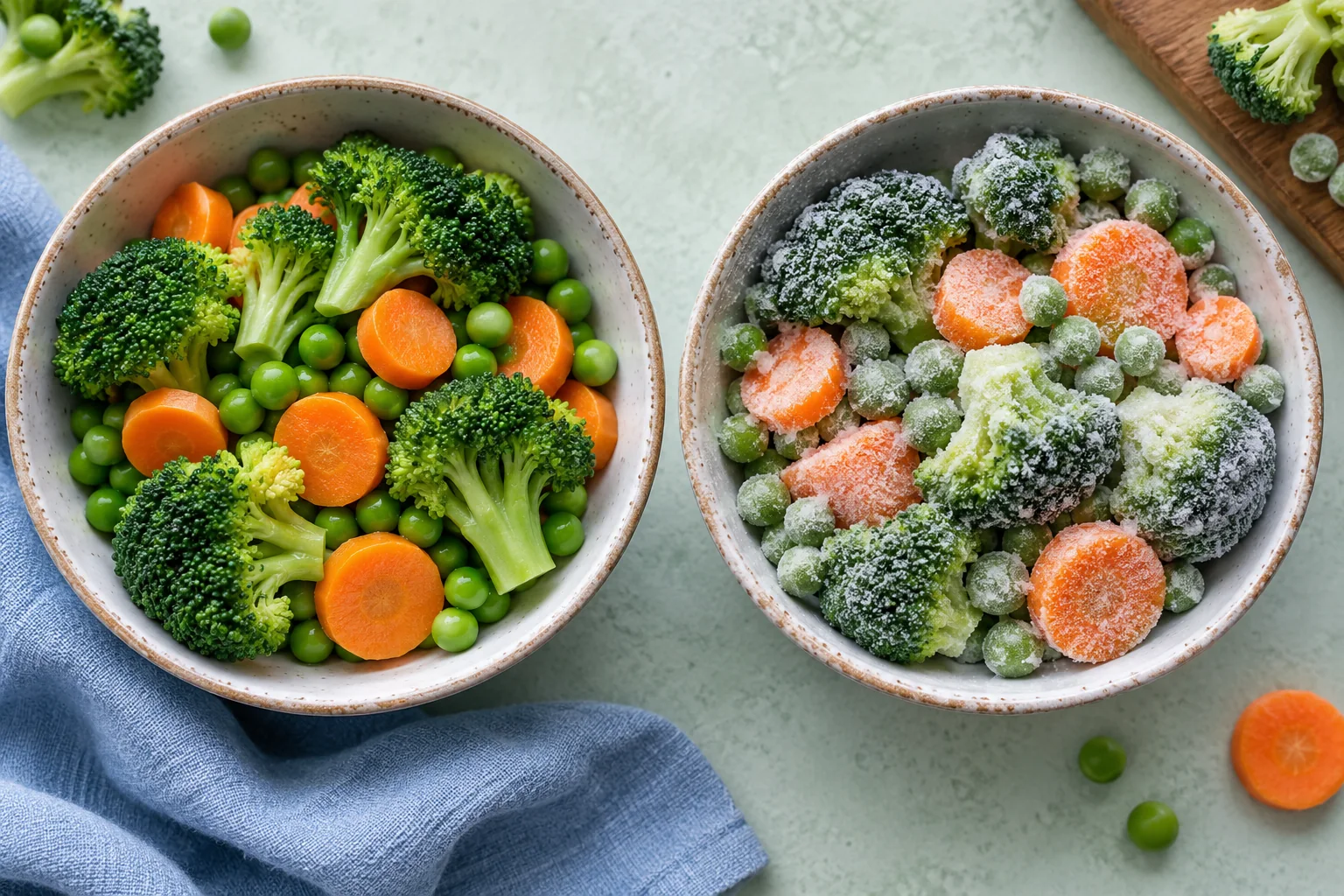
The fresh broccoli looks inviting. The frozen bag is easier to keep for a busy evening. Must convenience mean giving up nutrition? No. “Fresh” and “frozen” tell you something about handling, but they do not provide a complete nutrient score.
The better question is: when will you eat it?
Fresh produce eaten promptly is a different comparison from fresh produce sitting in a refrigerator until the weekend. That is the everyday gap the research below considered. A shopping decision should take account of your cooking plans, budget, taste and available storage, not just a reassuring word on the shelf.
The WHO’s healthy-diet guidance accepts frozen and canned fruits and vegetables as useful choices alongside fresh ones, while drawing attention to added sugars and excess sodium. That does not turn every frozen product into the same food: plain peas and peas in a salty sauce deserve separate consideration.
What was similar, and what was not?
In the 2017 laboratory study, most comparisons did not detect a significant difference in the measured vitamins between fresh, fresh-stored and frozen categories. Where differences occurred, frozen produce exceeded five-day fresh-stored produce more often than the reverse.
There were exceptions in both directions. Frozen peas compared favourably with stored fresh peas for several measured nutrients. Fresh spinach had more vitamin C than its frozen counterpart in this experiment. Fresh broccoli also had more measured beta-carotene and folate than frozen broccoli. These examples are why “frozen is always better” would be just as misleading as “freezing removes the nutrition”.
Absence of a statistically significant difference is not proof that every nutrient concentration was identical. The paper tested particular samples with variation between them. It did not measure every nutrient, every cultivar, every brand or every home-cooking method.
Freshness has a timeline
Fresh today
The study tested fresh produce on the day it was bought.
Fresh, stored
The other half spent five days in a refrigerator before testing.
Frozen
Store-bought frozen produce provided the third comparison.
Ask which nutrient
Vitamin C, beta-carotene and folate did not give one universal winner.
What does “sample size” mean in a food study?
No volunteers ate an assigned vegetable diet. Researchers combined produce from different stores into composite samples, then repeated laboratory measurements across six sampling periods. Repeating an assay improves measurement information; it does not turn one food sample into several independent human participants.
The three nutrients were vitamin C, beta-carotene and folate. The study therefore answers a limited nutrient-comparison question. It cannot show that people buying frozen vegetables have lower disease risk, or that one shopping strategy produces a healthier life.
Why does processing not give a simple answer?
The frozen vegetables had already undergone commercial handling, including blanching. The researchers also used specified preparation steps for different laboratory assays. Those steps, storage, varieties and moisture can affect the comparison. The categories were realistic supermarket choices, rather than identical produce split into a perfectly controlled fresh-versus-frozen experiment.
Funding came from the Frozen Food Foundation, which also selected the foods and nutrients to investigate. That is a relevant design and funding limitation, not a reason to discard every measurement or to hide the connection. The full accepted manuscript and publication record were reviewed; assay-validation supplements were not recovered, so we do not claim to have independently verified the laboratory methods.
Make the freezer work for your meals
Consider a mix: fresh items you enjoy and expect to use, plus plain frozen vegetables for meals when shopping is inconvenient. A handful of peas in a familiar dish, broccoli beside dinner or frozen spinach in a cooked meal are practical examples, not menus tested for clinical benefit.
Read the ingredients and distinguish the vegetable from sauces, salt and other additions. Follow the package’s storage and cooking instructions. This nutrient comparison is not a food-safety study and cannot tell you to ignore instructions or treat freezing as sterilisation.
The lesson travels well even though the samples came from US supermarkets: a label alone cannot tell you the whole story. Local availability, reliable cold storage and what you actually eat matter. You do not need to win a fresh-versus-frozen debate before putting vegetables into an ordinary meal.
Sources & further reading
- US · fresh, fresh-stored and frozen produce (2017)
- Public full accepted manuscript of the published 2017 paper
- University record confirming publication
- WHO: fresh, frozen and canned produce can fit a healthy diet
Study years differ from this article’s publication date. We reviewed full primary papers and relevant supporting material; access limitations are kept out of efficacy claims. Original illustrations and diagrams; no publisher figures reproduced. Educational writing, not clinical review.
Published 11 October 2026 · Sources checked 11 October 2026. Suggest a correction.