 PoshanSense
Can you follow a Mediterranean diet with your usual local foods?
You do not need an imported shopping basket. Understand the evidence for a Mediterranean-style pattern, then adapt its everyday food choices without promising identical results.
Complementary human studies · Published 2016 & 2018
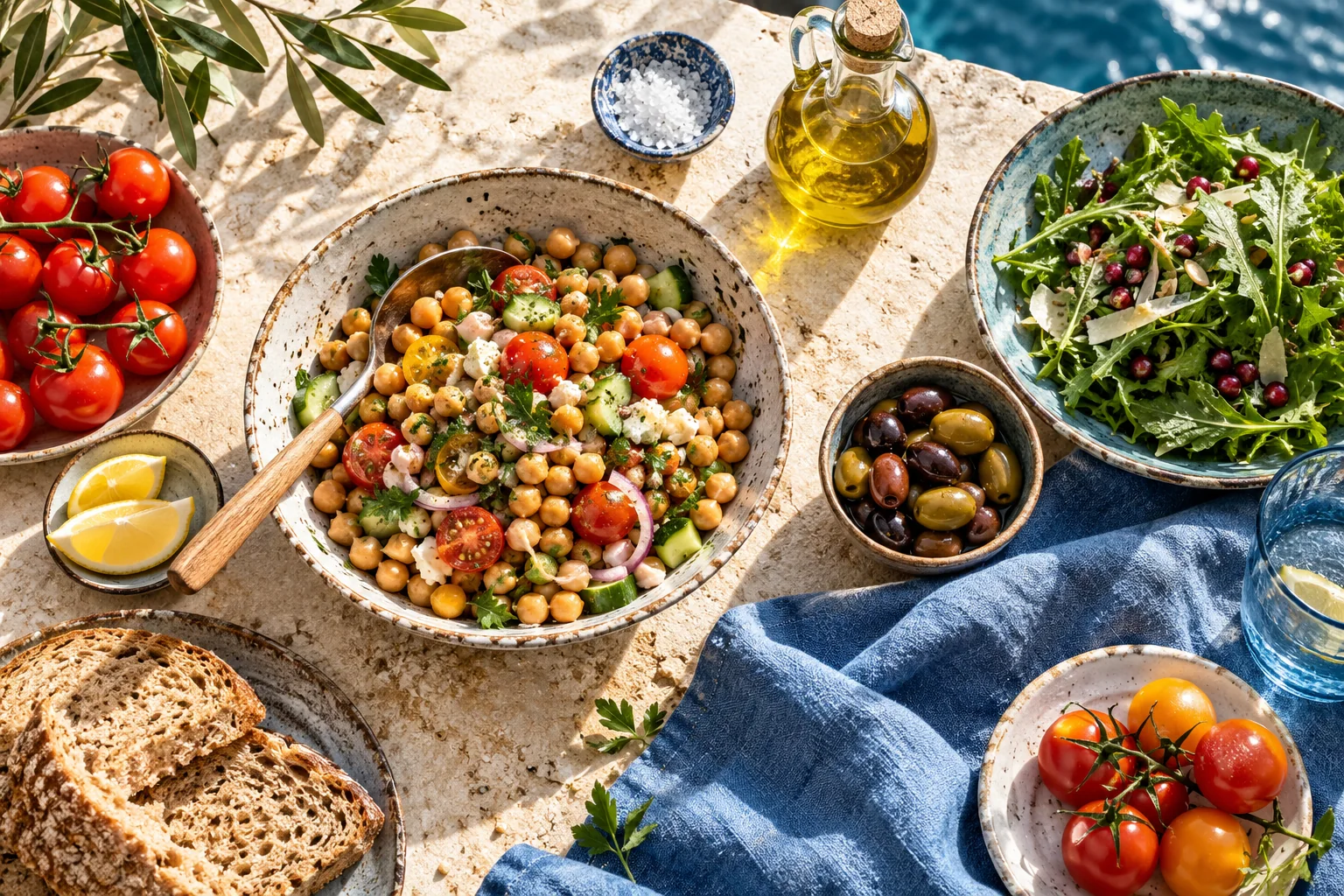
The picture usually comes with olives, a gleaming oil bottle and a seaside lunch. Your kitchen may have lentils, cabbage, frozen vegetables, rye bread, tortillas or rice. Does that mean a Mediterranean-style diet is out of reach? No. A dietary pattern can travel more easily than its name suggests.
What are you trying to copy?
Copy the recurring food choices rather than a restaurant theme: plant foods appearing throughout the week, pulses that are part of meals, and thoughtful choices about grains, fats and meat. An occasional salad beside the same routine is a smaller change than the whole pattern being studied.
For a US reader, that might start with beans in a familiar bowl. In northern Europe it might be a lentil soup and wholegrain bread. In India, a meal already containing dal and vegetables provides a useful starting point. These are examples of adapting a principle, not claims that researchers tested those particular lunches against each other.
Does it work outside southern Europe?
The UK cohort is useful precisely because participants lived in eastern England. Higher adherence was associated with fewer cardiovascular events. One score’s adjusted hazard ratio was 0.95 per standard-deviation increase: a modest relative association, not a prediction for your next meal.
The scores did not perform identically, and the study could not remove all differences between people who ate differently. It therefore supports relevance beyond the Mediterranean without proving that the pattern alone caused the difference.
What did the Spanish trial add?
In the corrected PREDIMED report, 7,447 adults at high cardiovascular risk received Mediterranean-diet support with olive oil or nuts, or advice to reduce dietary fat. Over a median 4.8 years, the combined cardiovascular endpoint occurred less often in both Mediterranean groups.
There is a crucial correction: the original 2013 report was withdrawn and replaced in 2018 after assignment irregularities emerged. The revised analysis addresses them; the trial should not be described as perfectly randomised throughout. It also does not prove that adding oil alone reproduces the whole intervention.
Translate the pattern, not the passport
Pulses
Beans, lentils, chickpeas or familiar dal can fill the pulse part of a meal.
Plants and grains
Use seasonal vegetables, whole fruit and wholegrain foods you actually enjoy.
Fats and portions
A suitable unsaturated fat is a food choice, not a reason to pour without measuring.
Evidence boundary
Practical substitutions are not separately proven to reproduce a clinical trial.
Keep familiar meals, change their balance
A practical first question is “where do these foods already fit?” A stew can include pulses and vegetables without being renamed. A sandwich can have a bean filling. A breakfast can include wholegrain oats and fruit without becoming a demonstration of authenticity.
That is often more useful than buying everything in a photograph. List the meals you actually repeat, the ingredients you can obtain, and the small changes you would still enjoy after a month. A pattern that exists only in an aspirational shopping basket does not describe what you eat.
Cost and preparation time matter here. Frozen vegetables and ingredients already in your cupboard may make a plan more realistic. This is practical reasoning about access, not a finding that one convenient ingredient has the same clinical effect as another.
Do you need expensive olive oil or wine?
The Spanish intervention supplied particular foods and repeated support. Its result does not establish that every oil is equivalent, nor that a premium product is necessary for every healthy diet. The broader WHO framework recognises cultural context and locally available foods while emphasising dietary balance and fat quality.
Wine sometimes appears in historical Mediterranean descriptions. Do not interpret that as an instruction to start drinking. A research scoring system and a personal health recommendation are different things; an alcoholic drink is not an admission ticket to eating more pulses and vegetables.
Also keep quantities visible. Nuts and oil can be useful ingredients without becoming unlimited extras. Consider what changed elsewhere in the meal when they were added. Replacing an ingredient and simply adding another are different routines.
A useful goal, without a guarantee
Ask whether your ordinary week contains the pattern you intended: varied plant foods, appropriate staples and meals that you can keep preparing. That question works across borders and is more actionable than deciding whether a dish looks sufficiently Mediterranean.
You can keep a short record of what you changed: the pulse added to a recurring meal, the vegetable that became easier to prepare, or the ingredient you replaced. It helps separate an intention from a routine, without turning a food journal into a medical outcome measurement.
The evidence supports taking the pattern seriously. It does not validate every adaptation individually, promise weight loss or replace cardiovascular care. The local-food approach is a way to make sound general principles usable while remaining honest about what was actually tested.
Evidence context: EPIC-Norfolk reports public/charitable funding and no competing interests. PREDIMED reports public and foundation support and food provision; its 2018 correction is part of the evidence, not a footnote to omit.
Sources & further reading
- UK · Mediterranean-style eating outside the Mediterranean (2016)
- 2018 corrected PREDIMED primary report
- WHO: healthy diets and cultural context
Study years differ from this article’s publication date. We reviewed full primary papers and relevant supporting material; access limitations are kept out of efficacy claims. Original illustrations and diagrams; no publisher figures reproduced. Educational writing, not clinical review.
Published 11 October 2026 · Sources checked 11 October 2026. Suggest a correction.