 PoshanSense
Does green tea help with weight loss—and are extracts the same?
Enjoying tea is different from taking a concentrated extract. Human trials and European safety assessment help separate small effects from marketing.
Complementary human studies · Published 2012, 2015 & 2016
A warm cup of green tea can be a pleasant part of the day. The promise becomes more complicated when the same ingredient appears on a bottle claiming to burn fat. Does the research support that leap? It helps to separate the drink, the extract and the outcome being advertised.
“Fat burning” is not the same as losing body fat
A laboratory measure of fuel use during a short period does not show how much body fat someone loses over months. Weight also changes with food intake, activity and other circumstances. A biological mechanism can be plausible without a product delivering a useful long-term result.
For this question, controlled trials measuring body composition are more informative than a dramatic claim about metabolism. They compare an assigned product with a control, while still requiring attention to who participated and whether people completed follow-up.
The longer trial did not show the advertised shortcut
The Minnesota substudy compared a decaffeinated extract with placebo over a year. It found no significant between-group improvement in overall fat mass, body-fat percentage or BMI. Its main overall results do not support presenting this extract as a reliable fat-loss aid.
Some exploratory patterns differed with participants' starting BMI. That can suggest questions for another study, but it does not overturn the overall result or identify a subgroup of readers who should take the product. The study also analysed women who completed the substudy, which limits certainty if withdrawals differed.
The paper tested a concentrated, measured product in postmenopausal women. It cannot answer every question about ordinary tea, men, younger adults or other formulations. Equally, those limitations are not evidence that a different commercial bottle must work.
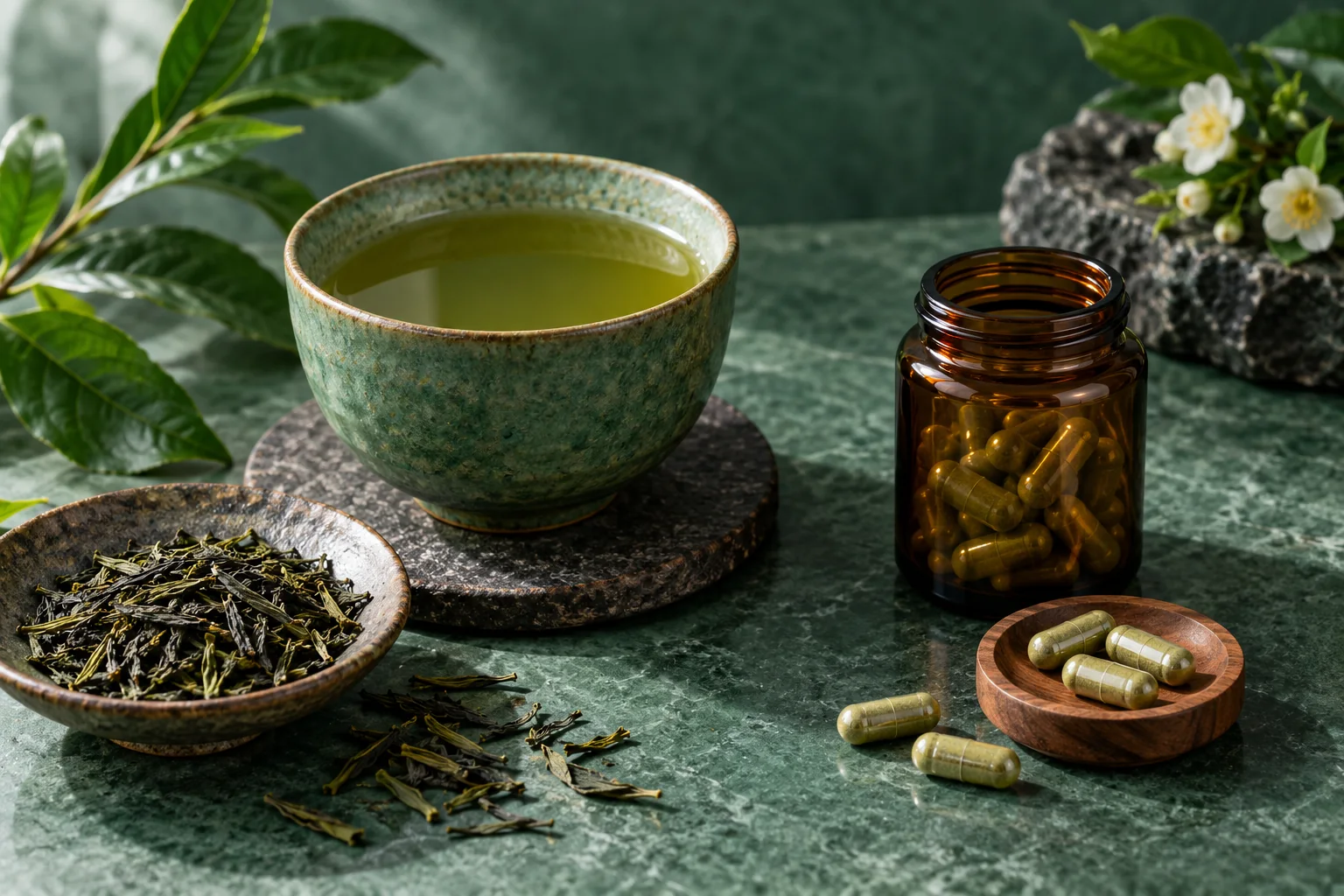
A cup and a capsule answer different questions
Brewed tea
A drink with a variable recipe and caffeine content.
Concentrated extract
A manufactured product with a different exposure to tea compounds.
Trial result
The year-long substudy found no overall body-fat benefit versus placebo.
Safety boundary
Capsule safety cannot be inferred from a familiar tea-drinking habit.
The wider literature is mixed, rather than a secret success
A 2012 Cochrane review examined green-tea preparations for weight loss and maintenance. Studies differed enough that the researchers analysed Japanese and non-Japanese trials separately. The pooled non-Japanese trials found a very small, statistically non-significant weight difference; Japanese results varied too much to combine into one estimate.
Those differences matter. Studies used different preparations, caffeine exposures and participants. A positive result in one setting cannot automatically be attached to every cup or capsule sold elsewhere. The review also found methodological weaknesses and no clear weight-maintenance benefit.
This is evidence about preparations, not proof that a plain cup produces the same exposure. It is also an older review, so it should not be described as the last word on all later studies. Its useful contribution is the warning against translating a mixed research category into a confident product promise.
More concentrated does not mean a better choice
The larger Minnesota safety analysis included all 1,075 randomised women. Liver-enzyme elevations occurred more frequently in the extract group than in the placebo group. Participants were monitored by researchers with rules for stopping the product.
That finding is not a reason to imply that an ordinary cup is equally risky. EFSA's assessment distinguishes traditionally brewed green tea from concentrated supplements. It considered traditional infusions generally safe at customary intakes while identifying liver concerns for supplements.
A supplement is therefore not simply tea made convenient. Its concentration, formulation, medicine interactions and the user's health can matter. This article does not recommend an extract or a dose; people considering one should discuss the specific product with a qualified professional.
Keep the cup in proportion
If you enjoy green tea, choose it as a drink you like. If it replaces a sweetened drink, the change in the drink's ingredients and portion is a separate explanation to consider. It is not evidence that tea compounds melt body fat.
Across countries, the useful approach is the same: ask which product was tested, what changed over time, and whether the result was clinically meaningful. A comforting routine can be worthwhile without needing a fat-loss promise attached.
Evidence context: Minnesota reports NIH and other public/university support, with study products supplied by Corban Laboratories; the body-composition authors declared no conflicts and no supplier role in study design or reporting. EFSA provides an independent European safety assessment. These sources do not establish identical effects across all populations.
Sources & further reading
- US · decaffeinated extract and body composition (2016 issue)
- 2012 Cochrane review of green-tea preparations for weight loss
- 2015 Minnesota trial safety report
- EFSA: brewed tea and supplement safety distinctions
Study years differ from this article’s publication date. We reviewed full primary papers and relevant supporting material; access limitations are kept out of efficacy claims. Original illustrations and diagrams; no publisher figures reproduced. Educational writing, not clinical review.
Published 11 October 2026 · Sources checked 11 October 2026. Suggest a correction.