 PoshanSense
Does handwashing prevent colds? Useful hygiene, without a universal promise
Handwashing is one prevention layer. A large Bangladesh trial explains why a hygiene programme can fail without proving that clean hands never matter.
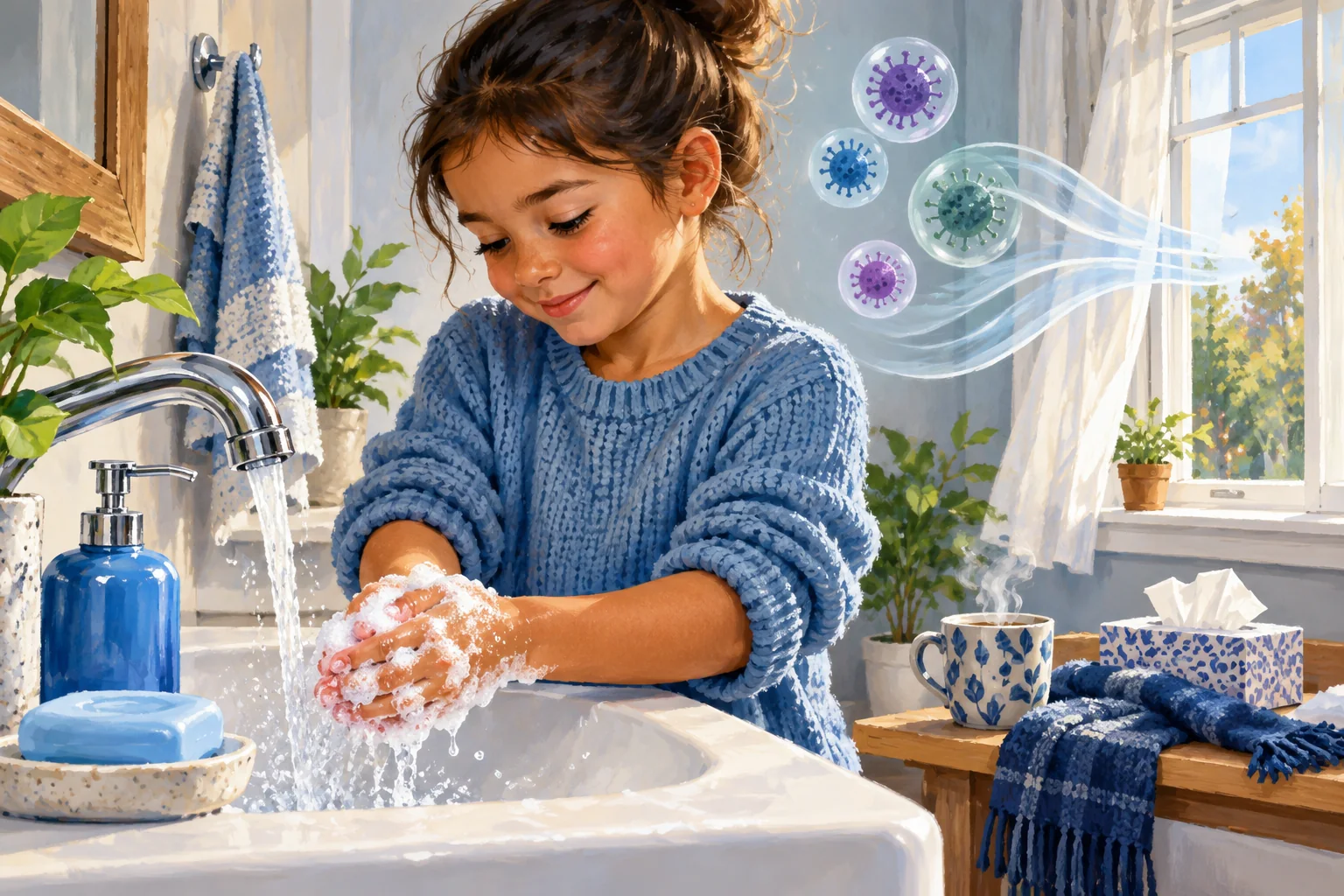
Research explained · Published 2019
You wash your hands regularly and still catch a cold. That can feel like proof that the advice is pointless. It is not: a useful preventive habit does not have to stop every infection, and a respiratory virus can reach you by more than one route.
What is handwashing realistically for?
CDC guidance includes hand hygiene because germs can move from hands to the eyes, nose or mouth, or between people and surfaces. Soap and water are the standard option; when unavailable, appropriate alcohol-based sanitizer is an alternative.
That does not mean clean hands address every exposure. Treat hygiene as one layer, rather than a replacement for other relevant precautions. A headline that promises “no more colds” asks more of the evidence than it can deliver.
Why did the Bangladesh programme not clearly work?
The Dhaka analysis found respiratory-illness prevalence of about 2.8% in the combined-intervention group and 2.9% in controls. The estimated relative risk was 0.97, with an uncertainty interval from 0.76 to 1.22. There was no clear reduction.
The intervention was a real-world package: vaccination, handwashing promotion and water treatment. It was not a tightly controlled experiment in which every person reliably changed one behaviour. Soap and water were available at assessed handwashing locations in about 45% of intervention households, compared with 28% of controls.
Incomplete uptake is part of the answer, not a reason to pretend the randomized result was positive. The programme as delivered did not establish a respiratory benefit. A more intensive programme, another setting or another infection might give a different result, but that possibility is not proof.
Does a null trial show that washing never helps?
No. It answers a particular programme question. The setting, package, uptake and self-reported outcome all affect what can be concluded. Equally, finding that households with soap and water had less illness would not rescue the randomized comparison: those households could differ in other important ways.
This is a useful distinction for health advice generally. A recommendation can have a plausible role while one implementation fails. The honest response is to describe the failure and its limits, rather than selecting only encouraging results.
One layer, not a force field
The practical role
Hands can transfer germs; hygiene remains useful.
The trial answer
The Dhaka package did not clearly reduce respiratory illness.
The implementation
Soap and water availability improved, but was far from universal.
The broader picture
Other prevention layers still matter for respiratory infections.
What should an ordinary household do with this?
Keep hygiene practical. Follow current public-health guidance about washing at relevant times, using soap and water, and avoiding transfer of germs to the face. Sanitizer is not a reason to ignore its directions or to assume every product is equivalent.
Do not turn the habit into a ritual that has to be repeated constantly to feel safe. More washing is not automatically more protection, and irritation can make a routine difficult to maintain. Seek appropriate advice if skin problems or excessive worry are interfering with daily life.
Also keep the broader exposure in view. Hand hygiene cannot make a crowded indoor interaction risk-free or replace recommended vaccination, cleaner-air measures and staying home when ill where applicable.
A realistic prevention mindset
Useful measures usually reduce particular risks rather than abolish them. Getting sick does not mean you failed morally, and a household should not be blamed for every infection it experiences.
The Dhaka study was supported by the Bill & Melinda Gates Foundation, which provided design input but had no reported role in data collection or analysis. Educational article; not clinically reviewed.
Sources & further reading
Study years differ from this article’s publication date. We reviewed full primary papers and relevant supporting material; access limitations are kept out of efficacy claims. Original illustrations and diagrams; no publisher figures reproduced. Educational writing, not clinical review.
Published 11 October 2026 · Sources checked 11 October 2026. Suggest a correction.