 PoshanSense
Does microwaving vegetables destroy their nutrients?
A Brazilian cooking experiment shows why nutrient changes depend on the vegetable, water and method rather than a blanket microwave verdict.
Research explained · Published 2021
A convenient microwave can acquire a surprisingly alarming reputation: it supposedly strips food of goodness while gentler-looking methods preserve everything. That neat ranking is not what a careful cooking experiment shows.
The first problem is the word “nutrients.” A vegetable contains many different substances. Measuring potassium is not the same as measuring a vitamin, and measuring a substance in cooked food is not the same as showing how much a person absorbs.
The vegetable changed the answer
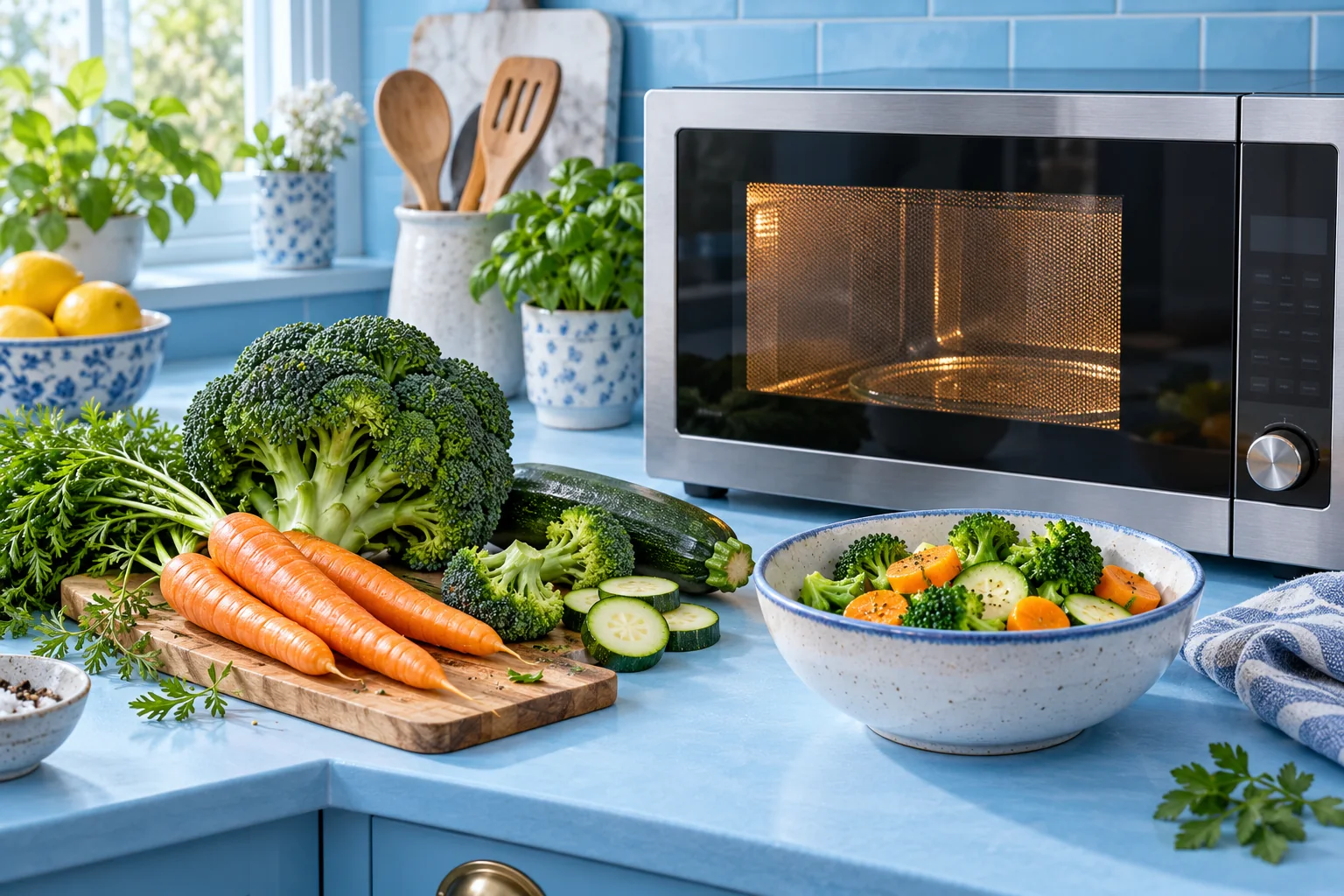
A Brazilian laboratory study compared five cooking methods using broccoli, carrots and Brazilian zucchini from conventional and organic cultivation. It measured minerals and carotenoids in raw and cooked samples.
The patterns varied by vegetable, growing method and nutrient. Some cooked samples yielded more extractable carotenoids than their raw counterparts; other comparisons showed reductions or little change. Microwave preparation was not a universal winner or a universal loser.
More measured does not mean created from nothing
Heat can alter the food’s structure, changing how readily a laboratory procedure extracts a compound. Water loss can also concentrate a substance in a sample. A higher measured concentration after cooking therefore does not necessarily mean the method created extra nutrient.
Similarly, lower content in the vegetable can reflect movement into cooking water rather than destruction of every molecule. Whether the water is discarded or becomes part of a dish changes the eating situation. A laboratory result needs that context before being translated into a kitchen rule.
The paper discusses nutrient accessibility, but its measurements were made on food samples. It did not feed the vegetables to participants and measure their absorption. We should not turn an extraction result into a claim that a particular appliance improves blood nutrient status.
This was not a test of every vitamin
The study measured sodium, potassium and carotenoids. It did not establish retention of every vitamin, protein or fibre component. A method that performs well for one endpoint might have a different effect on another.
Cooking settings also matter. The researchers used conditions selected for the foods and methods, rather than proving an appliance has a fixed effect regardless of time, power or water. A brief steaming preparation and a prolonged watery boil are different treatments, even when both use heat.
Four things behind a nutrient result
Which vegetable?
Carrot, broccoli and zucchini did not show one shared pattern.
Which nutrient?
Minerals and carotenoids are not interchangeable measures.
Which method?
Water, heating and preparation are part of the comparison.
Which outcome?
Food composition is not a trial of human absorption or health.
Do not make dinner harder than it needs to be
If the microwave makes vegetables practical on a busy evening, this experiment does not supply a reason to abandon it. If you prefer steaming, roasting or a pan, those can also be part of an ordinary routine. You do not need to optimise a laboratory number before putting vegetables on the table.
Compare the food you will actually prepare and eat. A method that produces an acceptable texture and fits your available time may be more useful than a theoretical ideal you rarely use. The experiment measured composition, not whether people maintained a vegetable-eating habit.
Keep the whole dish in view as well. Added ingredients, serving amount and what accompanies the vegetables are not captured by a single carotenoid result. A cooking method cannot be used as a health score for everything placed inside the appliance.
What remains uncertain?
The vegetables were purchased in one Brazilian region, and the organic and conventional samples differed in growing locations and periods. Ripeness was not assessed. Triplicate preparation helps describe a laboratory comparison, but it is not equivalent to hundreds of independent vegetable varieties.
The study had support from the Federal District research foundation and declared no conflicts. Those disclosures are useful alongside its narrow scope. Its practical message is reassuring without being absolute: cooking changes nutrients, microwave preparation does not have one blanket effect, and the answer depends on more than the name of the appliance.
Sources & further reading
Study years differ from this article’s publication date. We reviewed full primary papers and relevant supporting material; access limitations are kept out of efficacy claims. Original illustrations and diagrams; no publisher figures reproduced. Educational writing, not clinical review.
Published 11 October 2026 · Sources checked 11 October 2026. Suggest a correction.