 PoshanSense
Are omega-3 supplements as good as fish for your heart?
Fish, ordinary fish-oil supplements and prescription EPA answer different questions. What large US and international studies show about heart health, without a supplement shopping list.
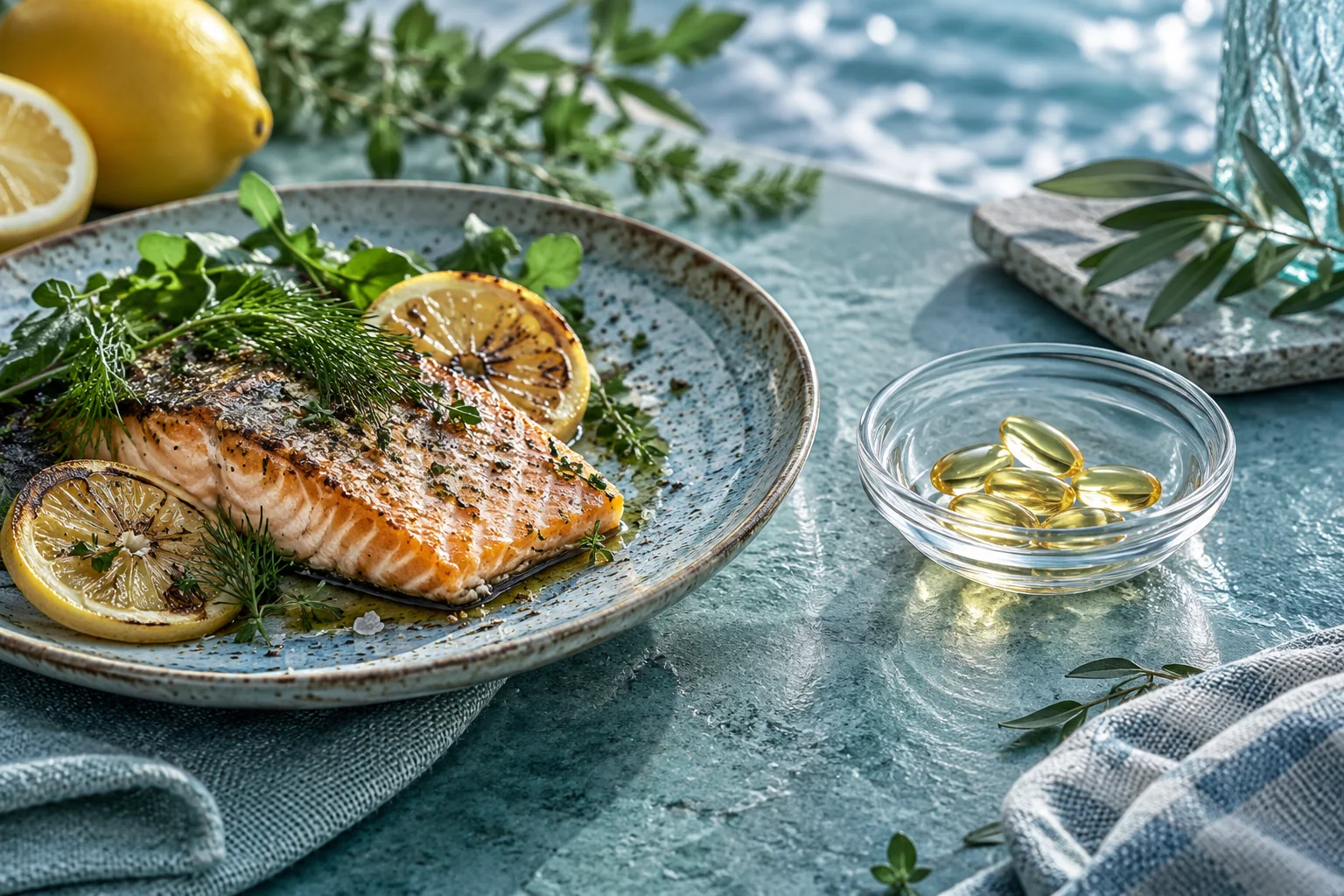
Complementary human studies · Published 2019–2021
There is fish on the menu and a fish-oil bottle in the cupboard. Both mention omega-3, so it is tempting to treat them as two ways of buying the same heart benefit. The clinical evidence is more specific: a meal, a supplement and a prescription medicine are three different questions.
For routine supplements, the promise is bigger than the proof
In the large US VITAL trial, major cardiovascular events occurred in 386 people assigned omega-3 and 419 assigned placebo. The hazard ratio was 0.92, with a 95% confidence interval of 0.80–1.06: no statistically clear reduction in the primary outcome.
Heart attacks alone were lower, but that was a secondary endpoint. It deserves attention without replacing the main result. A headline that quotes only the most favourable number leaves out the question the trial was principally designed to answer.
Would taking more solve that?
Not necessarily. The international STRENGTH trial tested a high-dose EPA/DHA formulation in 13,078 statin-treated, high-risk patients. Major events were almost identical: 12.0% versus 12.2% with corn-oil control. It also recorded more new atrial fibrillation in the omega-3 group, 2.2% versus 1.3%.
A change in a blood marker, including triglycerides, is not automatically a change in heart attacks or strokes. And “more” is not a reliable way to move from a disappointing result to a useful one. These are reasons to avoid experimenting with larger amounts after reading a headline.
Three things hidden behind “omega-3”
A fish meal
A whole food, its preparation and the meal it replaces. Cohort evidence is not a capsule trial.
A supplement
EPA/DHA amounts, formulation and tested population vary. A label is not a clinical outcome.
A prescription
A particular product for selected patients under medical care. Its result cannot endorse every bottle.
Then why do prescription omega-3 headlines sound positive?
REDUCE-IT tested a different product: purified EPA as prescription icosapent ethyl. Its 8,179 participants were taking statins, had raised triglycerides and established cardiovascular disease or diabetes with additional risk factors. Over a median 4.9 years, the primary endpoint occurred in 17.2% versus 22.0% with mineral-oil placebo.
The prescription trial also recorded more hospitalisation for atrial fibrillation or flutter: 3.1% versus 2.1%. A benefit and a risk can both belong to the same experiment.
That result matters. It does not turn a supermarket fish-oil bottle into the tested medicine. Formulation, eligibility, accompanying treatment and comparator all differed. Mineral oil's neutrality has also been debated. None of these differences can be settled by comparing the brand names on two shelves.
If a clinician has prescribed a product, this general article is not a reason to stop or substitute it. Equally, a successful prescription trial is not a reason for a healthy reader to start a lookalike supplement. The safest interpretation keeps the result attached to the actual experiment.
What does eating fish add to the picture?
A 2021 analysis of four cohorts spanning 58 countries found a favourable association between fish intake and cardiovascular outcomes mainly among people with vascular disease or high risk. It did not find the same clear association in the general population without vascular disease.
Fish intake was observed, not assigned. Even when participants came from medication trials, their fish meals were not randomised. The analysis therefore adds geographic breadth without proving that a particular dinner prevented an event—or that a capsule would reproduce the association.
Make the question useful in your kitchen
A fish dinner in Portugal, a salmon lunch in the US and a familiar fish curry elsewhere differ in species, preparation, portions and side dishes. Recording the actual meal is more informative than attaching a single nutrient label to it. What it replaces matters too: adding an extra meal is different from swapping one protein source for another.
Preference, allergy, access and cost also shape whether fish fits someone's diet. These studies do not say that everyone must buy it, or that a vegetarian diet needs an ordinary fish-oil capsule to become acceptable. Nor did they compare every plant or algal product. Unstudied alternatives should not inherit a result just because their packaging mentions omega-3.
A useful shopping question is therefore not whether the front of a bottle mentions fish. It is whether you are trying to change a meal pattern, correct a diagnosed problem, or follow a prescribed treatment. Those goals deserve different information. Choosing the goal first makes the evidence easier to use and the marketing easier to put in perspective.
A clearer takeaway
Ask “which product, in whom, and for which outcome?” before asking whether omega-3 works. Ordinary supplements, whole foods and prescription therapy should keep their separate evidence labels. A familiar meal can be part of a varied food pattern without a guaranteed heart claim, and a medical decision belongs with a clinician who knows your situation.
Evidence context: VITAL reports public research support and donated study agents; STRENGTH was funded by AstraZeneca, with sponsor involvement and author industry relationships. REDUCE-IT was funded by Amarin. The fish analysis reports mixed public and industry funding; its published correction concerns an author affiliation, not the results.
Sources & further reading
- US · VITAL omega-3 trial (2019)
- STRENGTH: international high-dose EPA/DHA trial
- REDUCE-IT: prescription icosapent ethyl trial
- Fish-consumption cohorts from 58 countries
- Fish-paper correction: author affiliation
Study years differ from this article’s publication date. We reviewed full primary papers and relevant supporting material; access limitations are kept out of efficacy claims. Original illustrations and diagrams; no publisher figures reproduced. Educational writing, not clinical review.
Published 11 October 2026 · Sources checked 11 October 2026. Suggest a correction.