 PoshanSense
Is pasta worse than rice or noodles for blood sugar?
Not necessarily: Singapore and Italian experiments show that carbohydrate foods differ by structure. Portion and the complete meal still matter.
Complementary human studies · Published 2021–2022
A pasta dinner is often described as “carb-heavy”, as though that settles whether it is a sensible meal. But rice, noodles and pasta all supply carbohydrate. The more interesting question is how the particular food is made, how much is served and what accompanies it.
You do not have to declare one cuisine the winner. A useful answer should help you compare the meals you actually eat, without turning a laboratory glucose curve into a universal menu.
Spaghetti did not lose this comparison
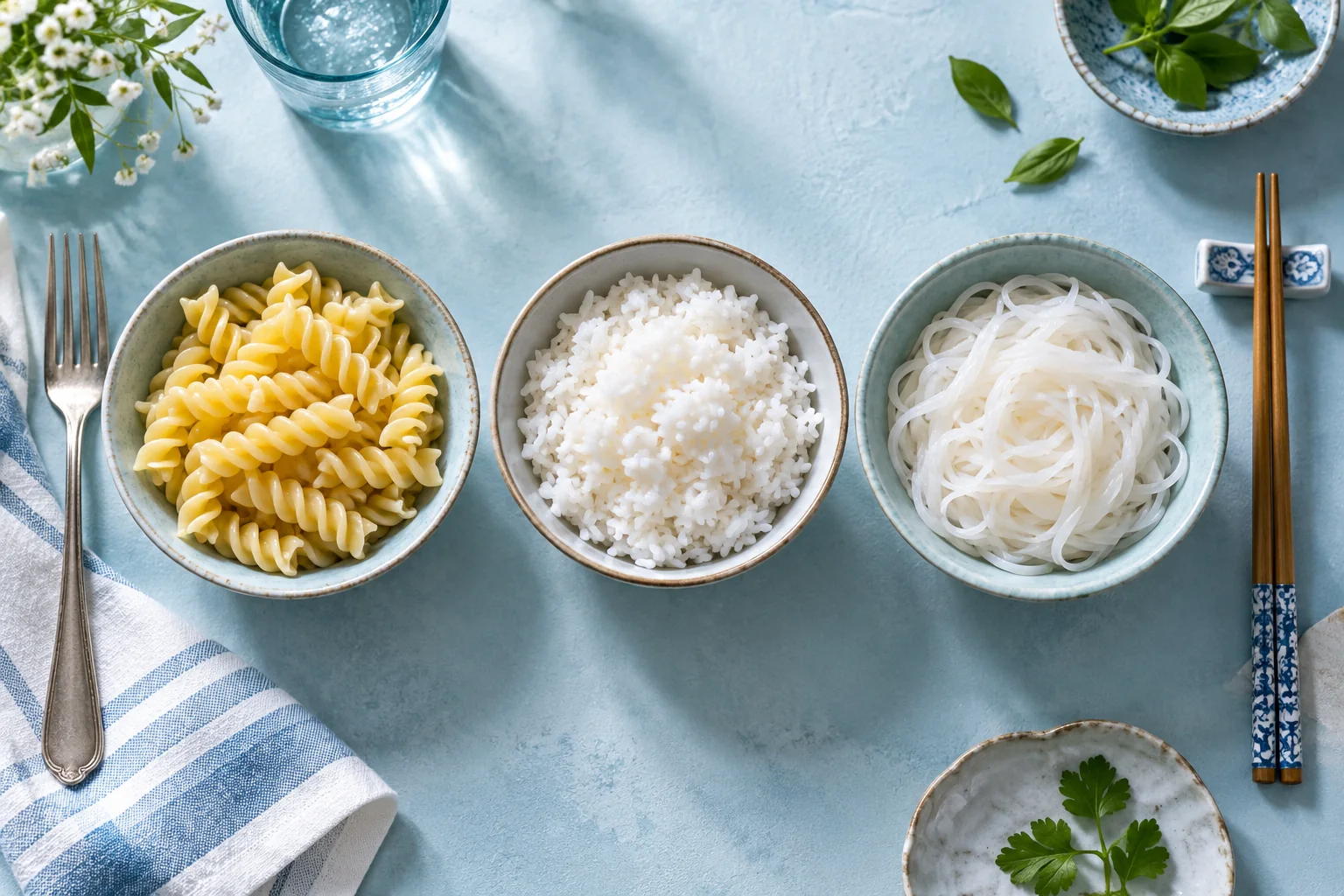
In a Singapore crossover study, semolina and wholegrain spaghetti had lower immediate glucose responses than jasmine rice and mee pok noodles. The researchers gave equal amounts of available carbohydrate, rather than equal spoonfuls or bowls.
Only healthy young adults were studied. Three completed datasets were removed as statistical outliers. This is evidence about the tested foods under controlled conditions, not proof for every pasta shape, noodle recipe or person with diabetes.
How can foods made from wheat behave differently?
The food's structure provides a plausible explanation. In two Italian meal trials, with 30 participants each, spaghetti and penne produced lower glucose responses than tested bread or couscous made from the same semolina ingredients. Separate chewing work in Finland and laboratory digestion examined how the structure broke down.
That helps answer why “same basic ingredient” does not always mean “same digestion”. It does not turn bread into a forbidden food or allow laboratory experiments to predict a complete dinner exactly.
Does that mean regular pasta beats wholegrain?
The Singapore study did not find a clear glucose-response difference between its two spaghetti products. That is a narrow result. Choosing wholegrain for its fibre contribution is a different question from asking which of two products produced the lower curve in one short experiment.
Do not make one metric do every job. An immediate glucose response does not describe all nutritional qualities, digestive preferences, cost or enjoyment. Conversely, a wholegrain label does not make portion irrelevant. Read the actual product and decide what comparison you want to make.
If you prefer regular pasta, this evidence does not say that the meal is automatically unsuitable. If you enjoy wholegrain, it does not supply a reason to abandon it.
A carb comparison is more than the ingredient
Structure
Extruded pasta and other wheat foods can digest differently.
Equal carbohydrate
Research portions were matched by available carbohydrate, not bowl size.
Complete meal
Sauce, vegetables, protein and serving size change the comparison.
Different outcome
An immediate glucose curve cannot prove long-term diabetes prevention.
Your bowl is not the test meal
The experimental staples were served without the kinds of sauces, vegetables and protein that many people add at home. A generous creamy dish and a smaller portion with vegetables are not interchangeable because both contain spaghetti.
Start by describing the whole meal. How much staple is on the plate? What else accompanies it? Is the comparison a substitution or an extra serving? These details are more useful than asking whether pasta has a better reputation than rice on social media.
There is also a measurement trap. Dry pasta, cooked pasta and cooked rice have different water contents. A per-100-gram entry needs the matching food state. Using a dry-food value for the weight of a cooked bowl can make a journal look very different from what was eaten.
What does this mean across cuisines?
The Singapore participants included Chinese and Indian adults, while the supporting glucose trials recruited in Parma, Italy. This broadens the context beyond an exclusively Western comparison, but it still leaves many everyday meals and populations untested.
Jasmine rice is not every rice variety, and mee pok is not every noodle. A rice-and-dal meal cannot be ranked against a pasta-and-sauce meal using the isolated staples alone. Cultural familiarity, affordability and the complete meal belong in the choice.
A useful adjustment can remain local: review the serving and accompanying foods rather than replacing a familiar staple solely because a headline favours another.
When individual advice matters
For someone managing diabetes, these experiments do not provide instructions for medicine or insulin adjustment. Follow the plan and glucose-monitoring advice agreed with your clinician. A lower average response in healthy volunteers is not a guarantee about your response.
The Singapore study had public research support and an unconditional Barilla grant; the Italian work was also Barilla-funded. Both measured short-term responses, not future disease. The practical answer is reassuring but limited: pasta is not automatically the worst carbohydrate choice, and a sensible comparison needs more detail than the name of the staple.
Sources & further reading
- Singapore · comparing familiar carbohydrate staples (2021)
- Italian glucose trials and Finnish chewing/structure work
Study years differ from this article’s publication date. We reviewed full primary papers and relevant supporting material; access limitations are kept out of efficacy claims. Original illustrations and diagrams; no publisher figures reproduced. Educational writing, not clinical review.
Published 11 October 2026 · Sources checked 11 October 2026. Suggest a correction.