 PoshanSense
Can prunes help protect bones after menopause?
A year-long trial found less hip bone-density loss with one prune intervention. Why that is promising food research, not proof of fewer fractures or an osteoporosis treatment.
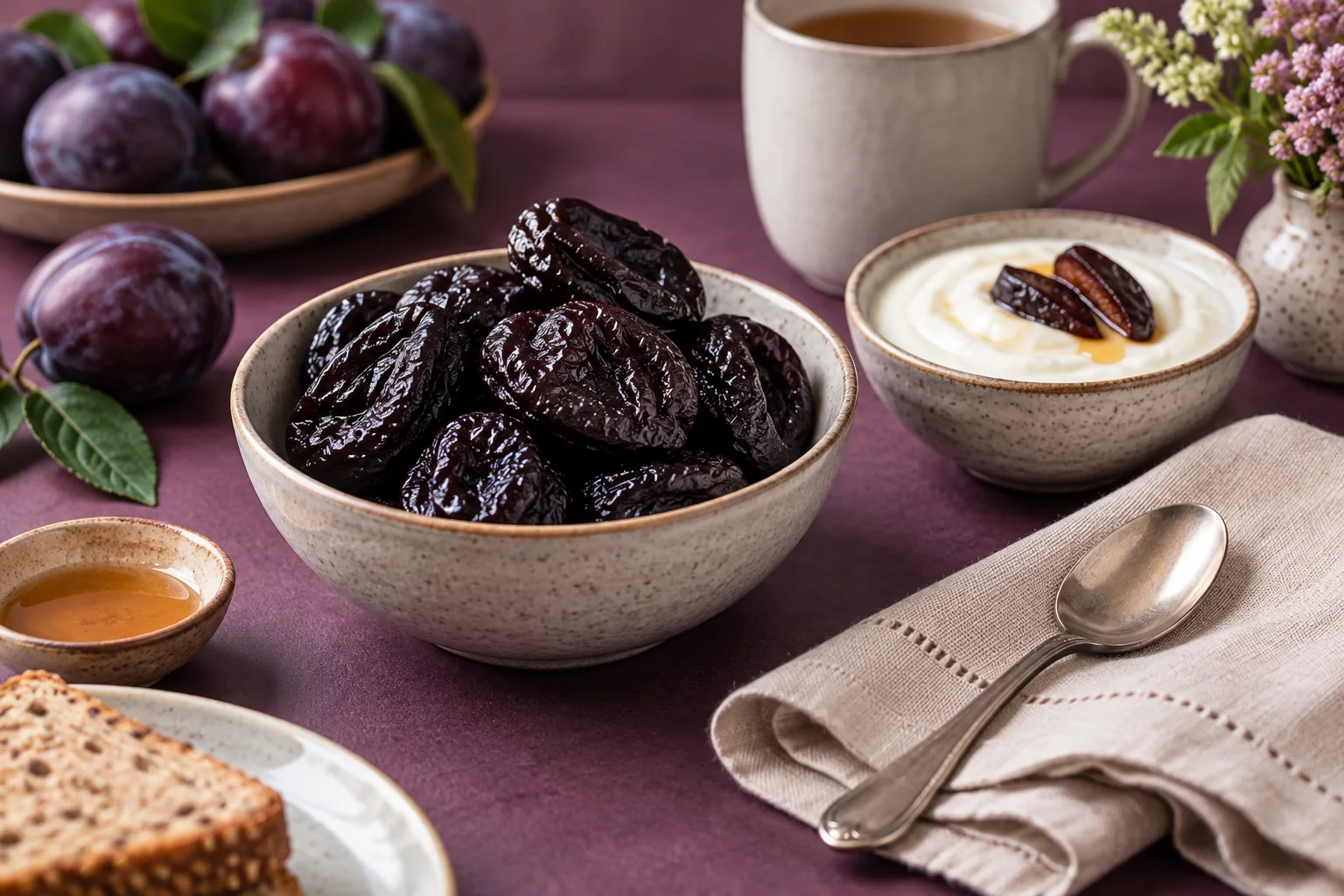
Research explained · Published 2022 & 2024
Prunes have an established place in the kitchen, but “good for bones” is a newer reason they appear in headlines. The idea is appealing: a familiar food rather than another complicated routine. The question is what the human trial actually permits us to expect.
Promising for one measured outcome
The Prune Study found less loss of total hip bone mineral density in the lower-prune group than in the no-prune group over roughly a year. That is a useful signal in postmenopausal food research.
Bone density is not the same as whether someone falls and breaks a bone. The study did not establish fewer fractures. Nor did every skeletal site or the higher-prune comparison show the same clear benefit. “Prunes build stronger bones everywhere” would be a much bigger claim than the result.
Why more was not a straightforward improvement
The higher-prune group had substantially more dropouts, often related to tolerability or the commitment required. This makes its result harder to interpret. It does not prove that a larger amount is harmful to bones, but it gives no simple basis for “double the food, double the benefit.”
Real-life usefulness includes whether someone enjoys and tolerates the food. A routine that looks impressive in theory may be difficult to sustain. The research question is not simply which group was told to eat the most.
The background care matters
Participants received support to meet the study's calcium and vitamin D intake requirements. Therefore, the comparison concerned adding prunes within that setting, rather than substituting them for those nutrients or medical care.
They were also selected postmenopausal women, mostly white, at one US centre. A reader elsewhere can learn from the experiment without assuming that its average result applies identically to younger adults, men, different diets or every osteoporosis risk profile.
Keep three levels of evidence separate
Food intervention
Whole prunes were tested alongside calcium/vitamin D support.
Measured result
One comparison favoured preservation of total hip bone density.
Still unanswered
The trial did not establish fewer broken bones or replace treatment.
Exploratory clue
Microbiome associations from the same participants are not a separate replication.
Does gut research explain who benefits?
A 2024 analysis looked at gut microbes among selected participants from the same trial. Twenty women classified as responders were compared with thirty-two non-responders. Some microbial characteristics differed, suggesting questions for future work.
Those groups were defined after the bone response was known, and responders started with lower bone density. Associations cannot show that a particular microbe caused the benefit, or that a commercial gut test can tell you whether to eat prunes. This was not an independent second trial confirming the original result.
Keep a food choice inside the bigger plan
If you like prunes, they can belong in a meal or snack. They need not be treated as a prescribed course. Consider the portion and the rest of the eating pattern, rather than adding a large new serving solely because a headline sounds protective.
A diagnosis of osteoporosis, previous fracture or concern about bone health requires individualized assessment. Do not replace treatment, stop medicines or plan a treatment break on the basis of this food study. Its measured effect was not established as equivalent to medication.
What should we take away?
The evidence gives prunes a plausible place in the conversation about food and bone ageing. The strongest practical interpretation is modest: a selected food intervention helped preserve one bone-density measure in one population.
That is interesting enough without turning it into a fracture-prevention promise. Future trials can test durability, broader populations and outcomes people ultimately care about, including fractures.
Evidence context: the California Prune Board funded and supplied the intervention; two authors disclosed advisory-panel roles. The later microbiome paper came from the same trial and is exploratory. Educational information; not clinically reviewed.
Sources & further reading
Study years differ from this article’s publication date. We reviewed full primary papers and relevant supporting material; access limitations are kept out of efficacy claims. Original illustrations and diagrams; no publisher figures reproduced. Educational writing, not clinical review.
Published 11 October 2026 · Sources checked 11 October 2026. Suggest a correction.