 PoshanSense
What should you replace red or processed meat with?
The replacement matters: beans, nuts, soy, poultry and a meat-free packaged product are different choices. Read the evidence without turning an association into a guarantee.
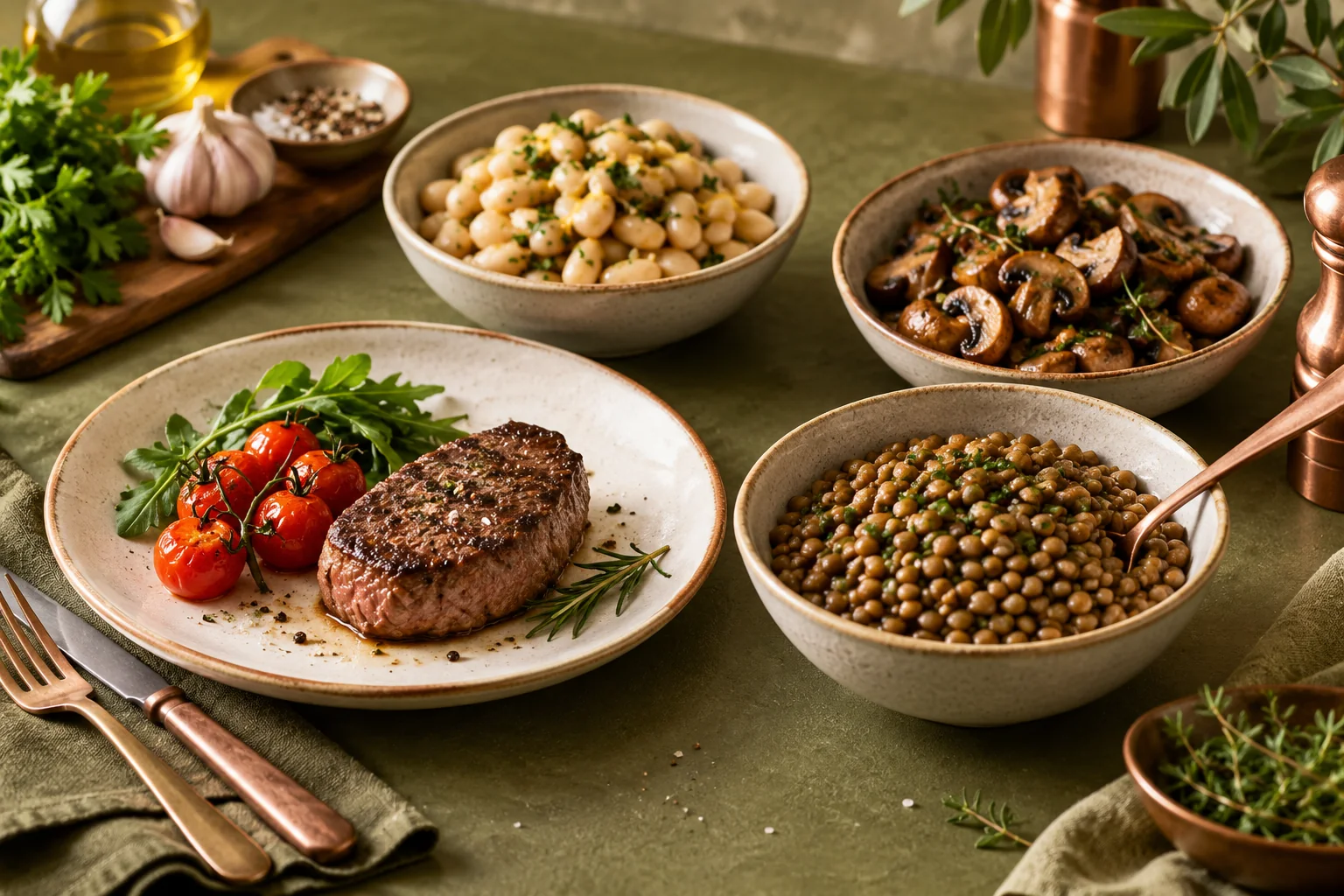
Complementary human studies · Published 2019 & 2020
You decide to eat less bacon, sausages or red meat. Then comes the more useful question: what goes in the meal instead? Removing an ingredient does not tell us whether lunch becomes a lentil bowl, a chicken sandwich or a packet of meat-free nuggets.
Ask about the next meal, not an empty plate
A swap is easier to understand when the replacement has a clear role. Beans can become the filling, lentils the base of a stew, and tofu an ingredient in a familiar dish. Nuts may fit a different meal or snack rather than replace a main course by themselves.
That flexibility matters across cuisines. A US chilli, a European bean stew, an Indian dal meal and another local pulse dish need not share a name to present the same practical question: what food took the place of the meat, and what else changed with it?
What does the long-term evidence suggest?
In the US cohort, modelled replacement of one daily serving of total red meat with combined nuts, legumes and soy was associated with a lower coronary risk: hazard ratio 0.86, with a 95% confidence interval of 0.80–0.93.
This describes a statistical comparison of reported diets. Nobody was randomly assigned a thirty-year lunch swap, and the figure is not the number of percentage points your risk will fall. The useful finding is that identifying the alternative makes the comparison more informative than asking whether meat is simply good or bad.
There is another practical boundary: this analysis grouped specific plant protein foods. It did not evaluate every branded meat-free product or prove that any food without meat would produce the same association.
Is chicken always a better replacement?
A 2019 controlled trial in California helps narrow that claim. It compared red-meat, white-meat and nonmeat diets over four-week periods, within higher- or lower-saturated-fat diets. In the 113 participants who completed all protein assignments, LDL and apoB were higher after either meat diet than after the nonmeat diet.
Red and white meat did not clearly differ for those measures. That does not make them identical in every way: the experiment measured blood markers, excluded processed meat and did not observe heart attacks. But it challenges the automatic assumption that moving from beef to chicken must improve every cardiovascular marker.
Name the replacement before judging the swap
Pulse-based meal
Beans, lentils or chickpeas can become the main ingredient, not just a garnish.
Soy or nuts
Different foods and portions; the evidence is not a brand endorsement.
Poultry
A different protein source, but not clearly better than red meat for LDL in one controlled trial.
Packaged alternative
Check the actual ingredients and label; “meat-free” alone is not a nutrient profile.
Do not turn every meat finding into one verdict
A UK Biobank analysis found associations between meat intake and several conditions, but also stressed the role of body size and remaining confounding. Unprocessed red meat and poultry were associated with lower iron-deficiency anaemia risk in that observational setting.
That is not an instruction to treat anaemia with meat. It is a reminder that “healthier” cannot be reduced to one endpoint and that a lower-meat plan still needs nutritional adequacy. The US cohort, a short feeding experiment and a UK observational study contribute different pieces; they should not be collapsed into a single certainty score.
How do you make a swap useful?
Begin with a meal you repeat. Name the ingredient, the usual portion and the replacement you would enjoy. A bean-rich filling with vegetables is a more concrete plan than “eat plant-based.” Keep the parts of the meal you like so the change has somewhere to live.
Also ask whether the replacement leaves the meal satisfying and varied. Different foods contain different amounts of protein and other nutrients. A token spoon of beans beside an otherwise reduced meal is not the same choice as building the meal around them.
The WHO’s general framework emphasises variety and balance. A label is only one part of that picture. Vegetarian, vegan, chicken-based and meat-free are descriptions, not complete evaluations of every serving.
What about a packaged meat alternative?
Look at the specific product rather than importing the evidence for beans or tofu. Compare the protein, sodium and saturated-fat information for the portion you eat. A product can be convenient without having been tested in the studies linked here.
There is room for practical choices, preferences and budgets. The research does not require an expensive product or a complete identity change. Equally, it does not justify calling every replacement protective merely because it contains plants.
The useful answer
For someone reducing red or processed meat, pulses, nuts and soy are sensible foods to consider, with supportive evidence. Build the answer around a real replacement meal, keep the overall diet adequate and avoid a personal disease guarantee.
If you have a diagnosed deficiency, pregnancy-related dietary needs or another medical restriction, a general substitution article cannot design the plan. Evidence can help frame better questions while the details remain personal.
Evidence context: the cohort reports NIH funding and no relevant financial relationships. The controlled trial reports NIH support, separate dairy-industry grants for two authors and an assay patent disclosure. These were reported alongside the findings.
Sources & further reading
- US · protein-food replacements and coronary events (2020)
- 2019 California controlled protein-source trial
- 2021 UK Biobank meat and health outcomes
- WHO: dietary variety and nutrient balance
Study years differ from this article’s publication date. We reviewed full primary papers and relevant supporting material; access limitations are kept out of efficacy claims. Original illustrations and diagrams; no publisher figures reproduced. Educational writing, not clinical review.
Published 11 October 2026 · Sources checked 11 October 2026. Suggest a correction.