 PoshanSense
Is sourdough healthier than ordinary bread—or wholegrain bread?
Sourdough describes fermentation; wholegrain describes the flour. A Belgian experiment helps explain why a better early glucose reading is not a weight-loss promise.
Complementary human studies · Published 2025
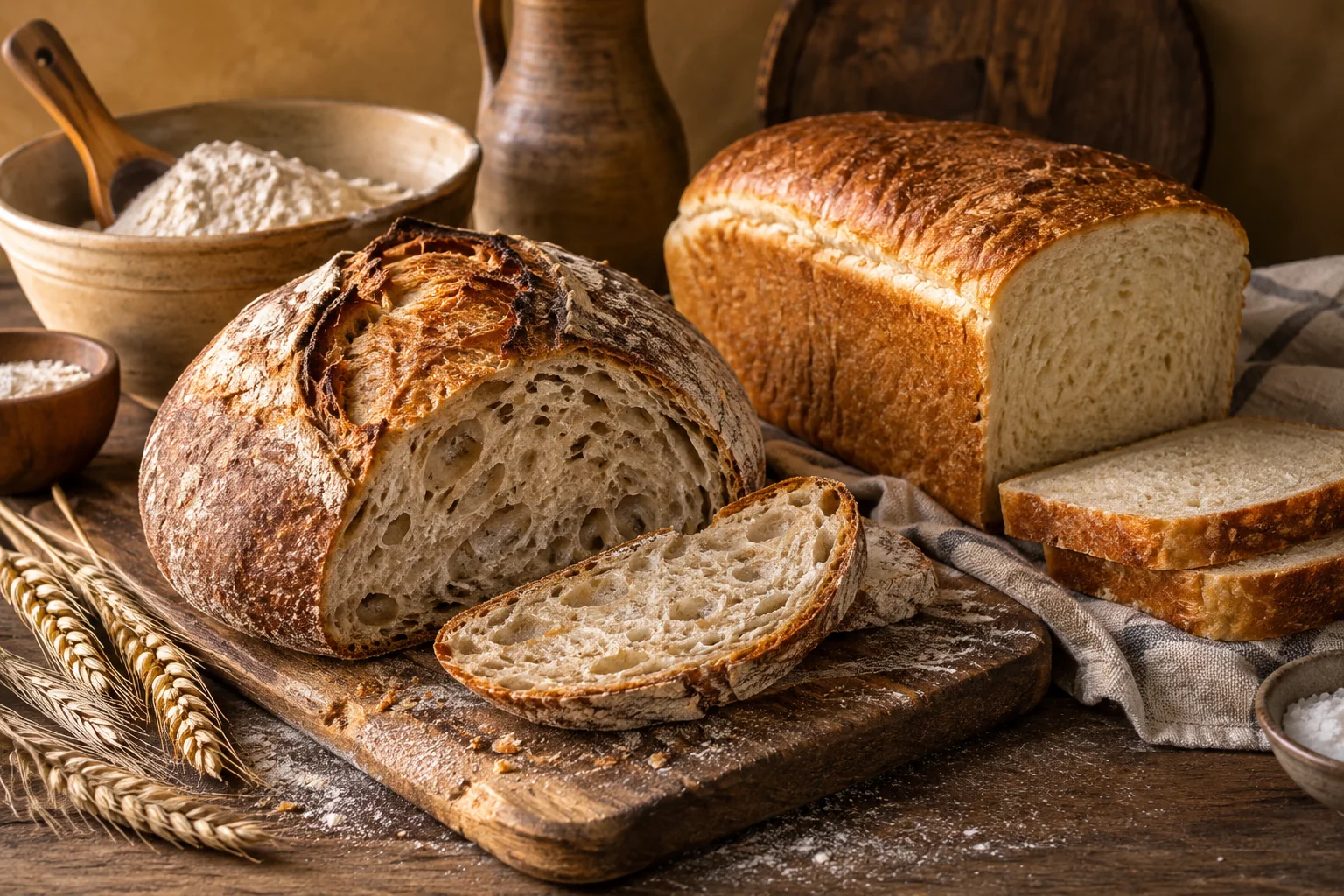
At a bakery, “sourdough” sounds like a complete nutrition verdict. It is actually the beginning of a question. What flour went into it? How was it fermented? How large is the slice? A rustic crust tells you very little about those details.
The most useful distinction is simple: sourdough and wholegrain are not rival teams. One describes fermentation and the other the grain ingredients. A loaf can be wholegrain sourdough, refined-flour sourdough, or wholegrain bread raised mainly with baker's yeast.
Start with the loaf you are actually buying
If your usual bread is wholegrain and a new sourdough is mostly refined flour, changing to the fashionable loaf is not automatically an upgrade. If the sourdough is also wholegrain, affordable and enjoyable, it may fit your meals perfectly well. Those are product decisions, not opposing dietary identities.
Compare labels on the same basis. Two slices can differ substantially in weight; a generous bakery slice may be very different from a thin packaged slice. Looking only at calories per slice can disguise that difference. Start with a comparable weight, then consider the portion you actually eat.
What does the best-matched experiment tell us?
The Belgian trial used a specially developed, lactic-acid-rich sourdough and a yeast bread with matching wholemeal flour. Forty-four people completed it. Sourdough slowed stomach emptying and reduced glucose at 15 and 30 minutes, but the total four-hour glucose response did not significantly differ.
Lunch intake—the main outcome—also did not significantly differ. Participants reported some appetite differences, yet those feelings did not produce a clear reduction in the food eaten later. The paper appeared online in December 2024 and in the 2025 journal volume.
That is an interesting result, but it supports a narrower answer than “sourdough keeps you slim.” A bread can change the timing of a short glucose response without demonstrating long-term weight loss. The same study can contain a positive secondary result and an inconclusive primary result.
Two labels, two different questions
Sourdough
How was the dough fermented?
Wholegrain
Which parts of the grain remain in the flour?
Nutrition panel
How much fibre and salt are in your serving?
Actual result
Early glucose differed; total response and lunch intake did not significantly differ.
Does a smaller early glucose rise mean fewer carbohydrates?
Not necessarily. Timing and total exposure are different questions. Imagine checking your journey only at the first traffic light: it tells you something about that moment, but not the duration of the whole trip. Similarly, an early glucose reading is not the entire response.
The practical mistake is converting “lower at an early time point” into “low-carb,” or “safe in unlimited quantities.” The bread portion remains bread. The experiment does not justify erasing it from a meal record or treating sourdough as a diabetes intervention.
Nor does it establish that an ordinary supermarket sourdough reproduces the research loaf. Fermentation cultures, time, flour and acidity differ between products. The word on the wrapper cannot tell you which experimental recipe it matches.
What should matter on a shopping trip?
Ask what you want from the swap. Better flavour? More fibre? A bread you can eat consistently within your budget? Those goals are more concrete than “healthier” without an explanation. You might keep your usual loaf and change the topping, or choose a wholegrain sourdough because you genuinely enjoy it.
Check the ingredient list, fibre and salt information, and the serving weight. Compare similar products, not a plain loaf against a seeded, sweetened or heavily topped version. If nutrition details are unavailable at a bakery, ask about the flour and ingredients rather than assuming that handmade means nutritionally superior.
A good meal also needs more than a good loaf. A sandwich, toast with a protein food, and bread eaten alone are different eating occasions. This particular bread trial does not settle every pairing. It gives you a reason to remain curious, without replacing the larger meal question.
What about digestion and gluten?
Do not interpret fermentation as proof that ordinary wheat sourdough is gluten-free. The Belgian study excluded coeliac disease and gluten sensitivity, so it cannot establish safety for those conditions. A health claim about sourdough is not a substitute for the product information and medical guidance you need.
For someone without those conditions, enjoyment and comfort can still influence the choice. But your own preference is not proof that a loaf repairs the microbiome or has a clinical effect. Those would require different evidence, different measurements and a more specific question.
Across countries, the wording on bread changes—wholemeal, whole wheat, wholegrain, rustic, artisan. Translate the decision into ingredients and portions rather than transferring a result from one Belgian recipe to every national bread tradition.
Evidence context: support came through the Flemish SourFun innovation project and Flanders' FOOD, with bakery and food-industry partners acknowledged. Authors declared no conflicts. The supplement was not recovered in this review; conclusions here use the main paper.
Sources & further reading
- Belgium · matched wholemeal breads (2025 issue)
- Primary paper: online December 2024, journal volume 2025
Study years differ from this article’s publication date. We reviewed full primary papers and relevant supporting material; access limitations are kept out of efficacy claims. Original illustrations and diagrams; no publisher figures reproduced. Educational writing, not clinical review.
Published 11 October 2026 · Sources checked 11 October 2026. Suggest a correction.