 PoshanSense
Does walking after meals lower blood sugar? What short walks can—and cannot—show
Small trials support lower short-term glucose responses with movement after eating. Learn what was tested before treating ten minutes as a universal prescription.
Complementary human studies · Published 2023 & 2025
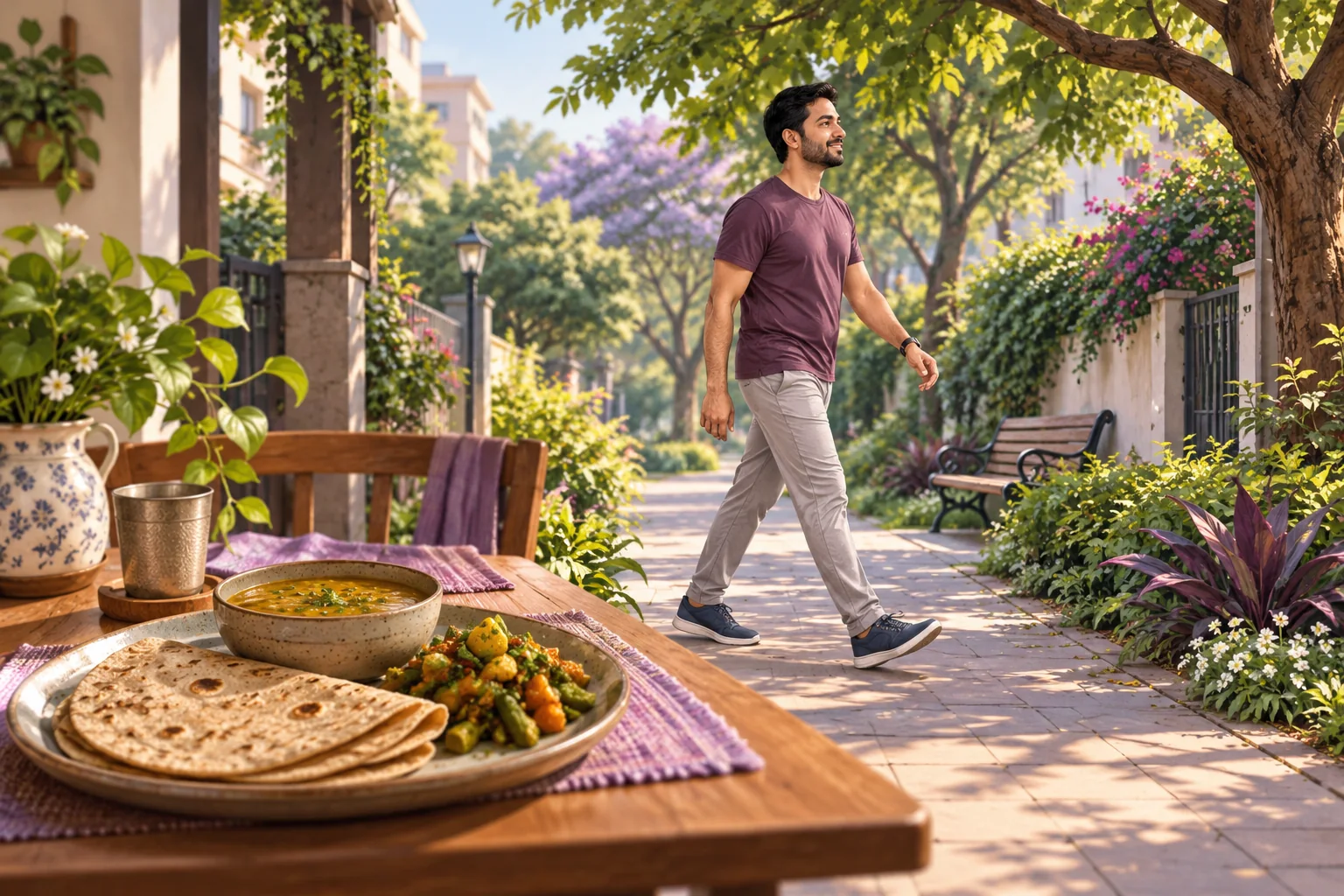
Dinner is over. The tempting choice is the sofa; the internet’s answer is a ten-minute walk. There is useful research behind moving after eating, but “ten” is not a magic number. The important questions are what people ate, when they moved and what researchers measured next.
The recent experiment tested a drink, not dinner
In Japan, 12 healthy young adults completed three conditions after a 75 g glucose drink. Walking immediately for ten minutes and walking for thirty minutes after a thirty-minute wait both reduced the overall two-hour glucose response versus rest. The study did not establish that ten minutes is equivalent to thirty, or isolate timing from duration: both changed between the walking conditions. Read the 2025 paper.
The three visits behind the headline
Same 12 adults · 75 g glucose drink at the start · 2-hour glucose follow-up
Both walking conditions lowered the overall response versus rest. Timing and duration both differed.
Why a real meal is a different test
A drink delivers a measured amount of glucose in a simple form. A meal combines ingredients, preparation and portion sizes. Dal, rice, roti and vegetables are not a laboratory glucose drink. The experiment helps answer a timing question under controlled conditions; it cannot forecast your response to a particular thali.
Nor does a lower two-hour response automatically mean lower long-term diabetes risk. To answer that, researchers would need a different study with a longer follow-up and outcomes that address prevention. A useful short experiment does not become useless because it cannot answer the bigger question.
The wider evidence points in a similar direction
The 2023 review brought together eight crossover trials. Overall, post-meal exercise reduced glucose responses compared with inactivity and with exercise before meals. But the studies were small, varied in their meals and activities, and were rated at high overall risk of bias. The before-versus-after comparison in the type 2 diabetes subgroup was inconclusive. That supports a cautious direction, rather than an exact timetable for every reader. Read the full review.
The point of combining these papers is to see whether their questions connect. The review supplies context from several settings and participants; the Japanese experiment gives a tightly specified example. Adding their sample sizes together would hide those differences, so we have not done that.
Make the habit fit the person
A routine you can repeat is more useful than chasing a perfectly timed internet challenge. Consider where walking is comfortable and practical: a safe corridor, a familiar route or another suitable space. A rainy evening, a crowded pavement or difficulty walking may change what is feasible. The paper did not compare those everyday choices.
Do not use a walk to justify larger portions or to label a meal “paid for.” Food logging and movement can be ordinary habits without becoming a transaction. If you keep a journal, record what you actually ate rather than subtracting an invented glucose benefit.
What if you have diabetes?
The twelve-person experiment is not a diabetes-management protocol. If medication, low-glucose episodes, mobility problems or symptoms affect activity, discuss timing with your care team. No medication changes or target glucose values follow from this article. Stop activity that makes you feel unwell.
The Japanese authors reported no specific grant and no conflicts; the review disclosed institutional open-access support and no competing interests. The practical conclusion is modest: post-meal movement is worth understanding, while the exact timing and long-term effect remain less certain. Keep the comparison attached when sharing the headline: short-term glucose, specific conditions, small trials.
Sources & further reading
Study years differ from this article’s publication date. We reviewed full primary papers and relevant supporting material; access limitations are kept out of efficacy claims. Original illustrations and diagrams; no publisher figures reproduced. Educational writing, not clinical review.
Published 10 October 2026 · Sources checked 10 October 2026. Suggest a correction.