 PoshanSense
Is fruit juice as healthy as whole fruit?
Whole fruit and juice are different choices. Cohorts and short trials do not give identical answers, and the label “100% juice” does not make them interchangeable.
Complementary human studies · Published 2013 & 2017
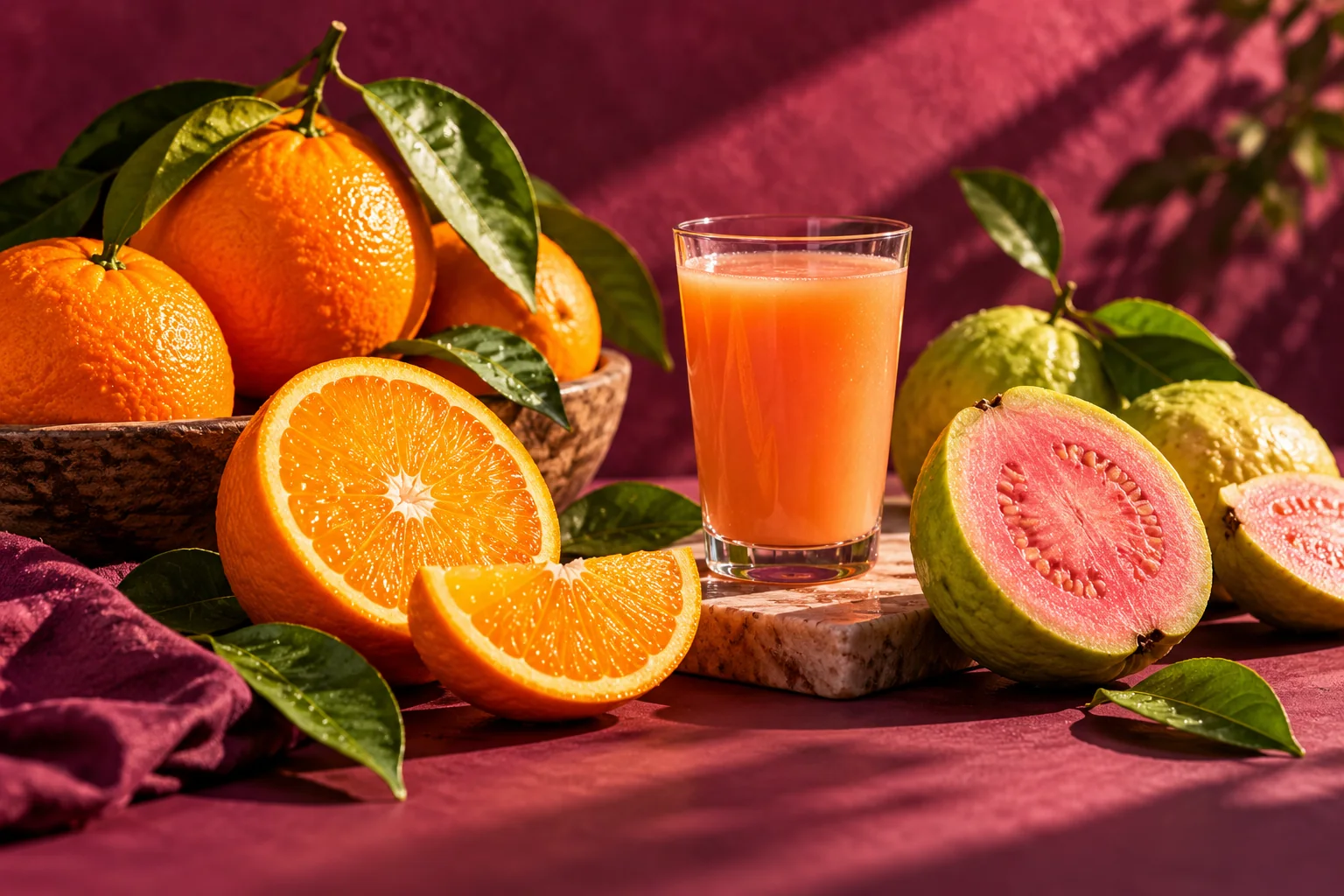
Would you rather eat two oranges or drink their juice? The ingredients might begin in the same place, but the finished foods are not identical. That is a better starting point than sorting them into “natural, therefore unlimited” and “sugar, therefore poisonous”.
Whole fruit and juice serve different roles
Whole fruit brings its edible structure and usually more fibre into the eating experience. Juice can be consumed quickly, with a portion that is easy to overlook. A small glass and a large bottle are also different servings, even when both say 100% juice.
This does not mean juice has no nutrients or that one drink defines your diet. It means a glass should not automatically be counted as an equivalent experience to eating the fruit. Think about what it replaces and how often it appears rather than judging from the word “natural”.
Long-term observational research supports a preference, not a guarantee
The three US cohorts associated greater whole-fruit intake with lower diabetes risk and juice with higher risk. Importantly, the paper had a coding correction. The revised modeled replacement of three weekly juice servings with whole fruit corresponded to about 5% lower relative risk, not the original 7% headline.
It was a statistical comparison among existing habits—not a trial asking people to exchange drinks. A relative association cannot predict what happens to one person after a single glass.
Same starting ingredient, different question
Whole fruit
Structure, fibre and an eating occasion.
100% juice
A beverage; notice the actual glass or bottle.
Research comparison
Long-term associations and short-term markers answer different questions.
Why do other studies sound less alarming?
The Women’s Health Initiative analysis did not find a clear main association between moderate reported 100% juice consumption and diabetes in older US women. Differences in people, intake patterns and measurement can change results. We retain that finding rather than select only the most dramatic cohort.
A review of 18 randomized juice trials likewise found no clear overall effect on several glucose-related markers. Those shorter trials measured biomarkers and used varied control drinks. Comparing juice with a sugar-matched drink answers a different question from replacing water with juice, and neither directly tests decades of disease risk.
Check what the bottle actually contains
A juice drink, nectar, smoothie and 100% juice are not automatically the same product. Read the ingredient list, serving information and sugar content rather than treating the front label as the full explanation. A “no added sugar” statement does not mean that the drink contains no sugar.
A blended whole-fruit smoothie may retain more fruit material than strained juice, but these papers do not establish that every smoothie is equivalent to whole fruit either. Recipes, portion size and added ingredients can vary widely. It is better to describe the actual drink than to assign it a broad health category.
Do you need exotic fruit?
No conclusion here requires importing the fruit that happened to receive attention in a US cohort. Guava, oranges, apples and other fruits can be chosen around preference, availability and your overall diet. Ranking one fruit as a disease-prevention tool would be more specific than these studies can support for your routine.
The meal context still matters. A glass alongside a substantial breakfast is not the same change as replacing a sugary drink, and neither is identical to replacing an afternoon whole-fruit snack. “Healthy compared with what?” remains a useful question.
The everyday answer
Keep whole fruit as a practical default when you want fruit, and treat juice as a drink with a serving worth noticing. Avoid both a free pass for a large bottle and a frightening claim that an occasional glass causes diabetes. The stronger habit is understanding the choice you are making.
A journal can distinguish a whole-fruit snack from a juice serving and show how it fits the day. It cannot calculate your disease risk or replace clinical guidance. The studies support a measured preference with caveats, rather than a rule built around fear.
Evidence context: the cohort paper reported NIH funding and no relevant financial conflicts. The juice review was funded by the Juice Products Association. We use the corrected cohort estimate, retain the null findings and do not combine their participants into one experiment.
Sources & further reading
- USA · three fruit cohorts, 2013
- Correction: coding error and revised whole-fruit substitution estimate
- Women’s Health Initiative fruit and juice analysis
- 2017 randomized juice trial review
Study years differ from this article’s publication date. We reviewed full primary papers and relevant supporting material; access limitations are kept out of efficacy claims. Original illustrations and diagrams; no publisher figures reproduced. Educational writing, not clinical review.
Published 11 October 2026 · Sources checked 11 October 2026. Suggest a correction.