 PoshanSense
Are nut butters as healthy as whole nuts?
Grinding changes how almond energy becomes available, but does not make nut butter unhealthy. US and UK trials explain what food form can and cannot tell us.
Complementary human studies · Published 2016 & 2022
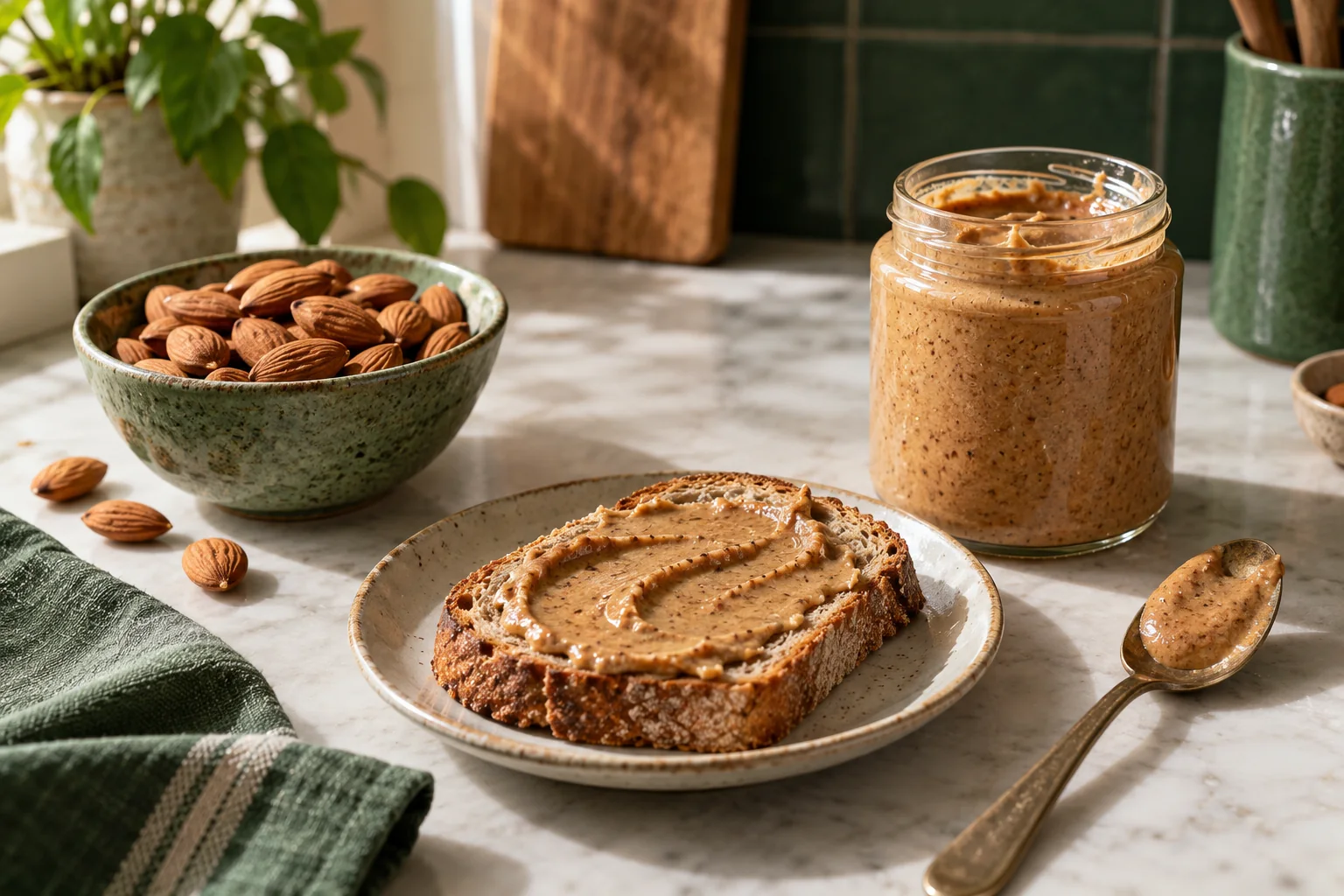
A spoon of almond butter and a handful of almonds begin with the same food. But one crunches and the other spreads. That difference is more than a matter of breakfast preference: it changes the structure your digestive system encounters.
The useful question is not which one deserves a health halo. It is whether they are interchangeable for the purpose you care about: convenience, texture, portion awareness or an outcome measured in a trial. Those purposes do not all have the same answer.
Grinding changes access, not the existence of calories
In a US controlled-feeding experiment, smooth almond butter provided more metabolizable energy than whole or chopped almonds. Metabolizable means the energy remaining after losses through stool and urine, not simply the energy obtained by burning a food in a laboratory.
The researchers kept participants’ weight stable rather than testing weight loss. Their finding helps explain why food structure matters; it does not establish that choosing butter instead of nuts makes a person gain weight.
Why that is not a personal calorie discount
A food label, a database entry and a measurement from a particular experiment serve different purposes. The study average cannot reveal how much you individually absorb from your own portion, product and meal. Applying a fixed deduction to every nut entry would add false precision.
There is a simpler practical route. Record the product and amount you actually used. A level spoon, a heaped spoon and butter spread across several slices are different amounts even when all three are casually described as “some nut butter”. Consistency is more useful than pretending a laboratory average is your personal digestive result.
The same principle applies to whole nuts. A packet eaten gradually at a desk can be harder to estimate than a portion placed in a bowl. Choosing a crunchy form does not remove the need to notice the quantity.
Does whole automatically mean better for your gut?
A London trial offers a useful counterpoint. It randomised 87 adults to whole almonds, ground almonds or energy-matched muffins for four weeks; 79 entered the modified main microbiome analysis. Whole and ground almonds did not clearly differ in the measured gut outcomes, and the primary bacterial outcome showed no clear benefit after adjustment for multiple comparisons.
That trial used ground almonds, not a jar of smooth butter. It cannot settle every butter question. It does show why a structural difference should not be promoted into a guaranteed advantage for gut health. Different outcomes need their own evidence.
Same nut, different questions
Whole
Cell structure can keep some energy less accessible during digestion.
Smooth butter
Grinding changes structure; portion and ingredients still matter.
Ground flour
Not identical to butter: a separate UK trial found no clear gut advantage by form.
Your choice
Compare the food you actually eat, rather than applying a universal calorie discount.
Read the jar, not just the front label
Start with the ingredient list. A jar containing nuts alone answers a different comparison from a sweet spread with nuts among several ingredients. Added sugar, salt and other ingredients should be judged from the actual product rather than assumed from the words “natural”, “protein” or “premium”.
Then compare like with like. Almond butter against whole almonds is a form comparison. Almond butter against peanut butter also changes the ingredient. A sweetened spread against unsalted nuts changes several things at once. When the comparison changes, the explanation needs to change too.
Price and everyday use matter. A food that is practical and enjoyable can be easier to include regularly. There is no reason to purchase an expensive butter solely because a small experiment measured digestion in almonds.
Choose the form that fits the meal
Whole nuts can work as a separate snack or a crunchy addition. Butter may be convenient in porridge or on toast. These are meal ideas, not trial-proven prescriptions. Ask what you are replacing: a spread, part of a snack, or nothing at all. Adding a new food on top of your usual intake differs from making a substitution.
For an adult who finds whole nuts difficult to chew, insisting on the intact form may be unhelpful. Texture needs and individual advice take priority over an internet ranking. Nut allergy remains relevant whichever form is chosen; grinding does not make an allergenic nut safe.
How confident is the comparison?
The US work had USDA and Almond Board of California support and declared no conflicts. The UK trial also had Almond Board funding and disclosed relevant research relationships. Both examined short interventions. They offer useful pieces of the answer, rather than a universal ranking of every nut product or evidence that a particular brand is best.
Keep the decision ordinary: choose an appropriate product, notice the portion and use the form that works in your food. You do not need to turn every breakfast into a digestion experiment.
Sources & further reading
- United States · almond form and absorbed energy (2016)
- London whole-versus-ground almond gut trial
- Open university copy of the energy study
Study years differ from this article’s publication date. We reviewed full primary papers and relevant supporting material; access limitations are kept out of efficacy claims. Original illustrations and diagrams; no publisher figures reproduced. Educational writing, not clinical review.
Published 11 October 2026 · Sources checked 11 October 2026. Suggest a correction.