 PoshanSense
Does cooling and reheating rice really lower its blood sugar impact?
Resistant starch is real, but rice does not become carb-free. Small Indonesian and Polish experiments explain the promise, safety and insulin caveat.
Complementary human studies · Published 2015 & 2022
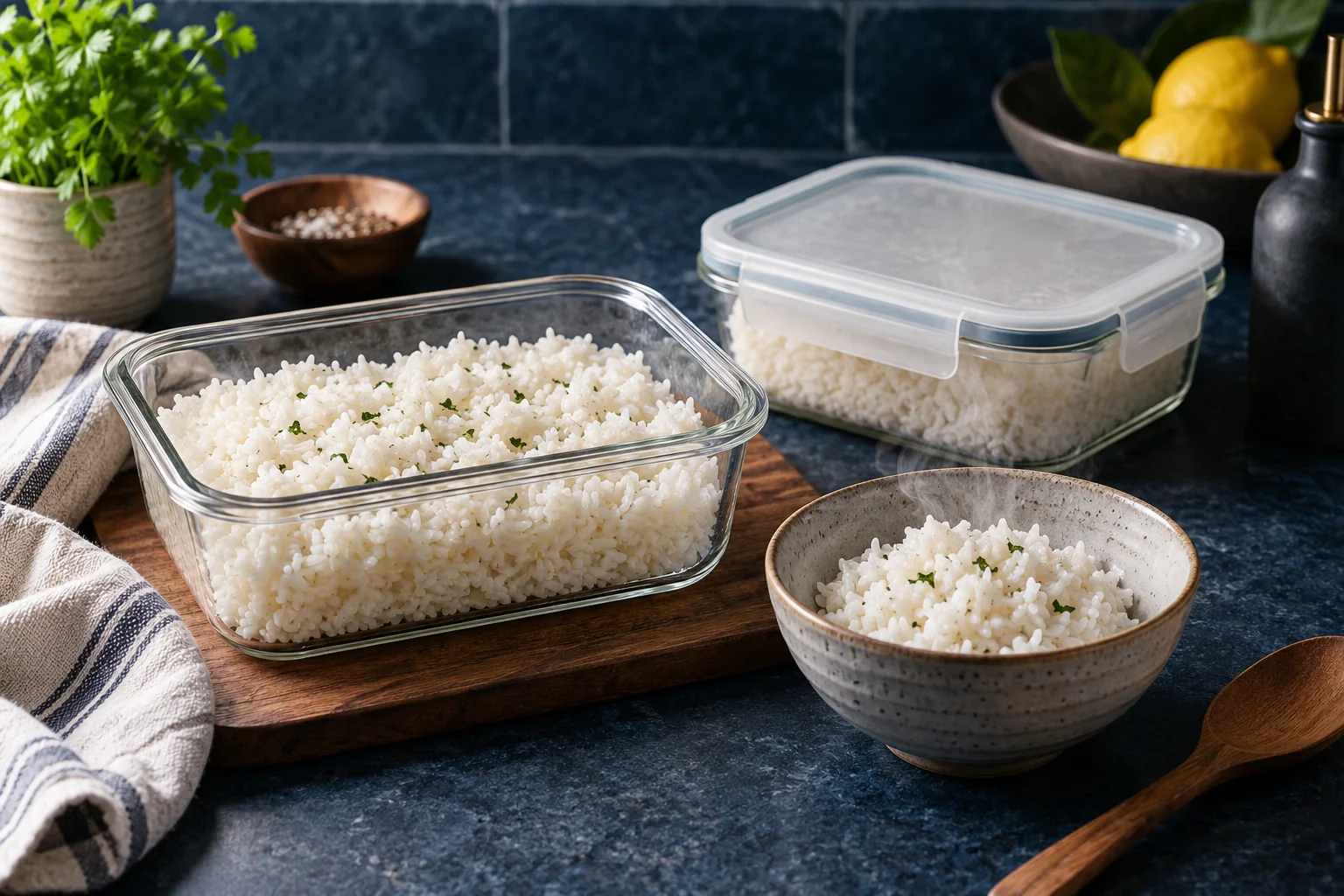
The same rice, yesterday and today: can the refrigerator really change what happens after you eat it? The appealing answer is yes, a little of its starch can change. The less appealing but more useful answer is that this is not a way to make an unlimited rice portion disappear from your carbohydrate intake.
Think of cooling as a change in the food, not a cancellation of the food. A leftover rice bowl still needs the same ordinary questions: how much rice is there, what accompanies it, and was it stored safely? Those questions survive the clever kitchen chemistry.
What actually changes when rice cools?
Cooking makes rice starch easier to digest. As cooked rice cools, some starch reorganizes into structures that resist digestion in the small intestine. Researchers call this retrogradation, and the resulting fraction resistant starch. Reheating does not necessarily undo the whole change.
That gives a plausible reason for a different glucose response. It does not mean every variety behaves identically or that a home container has a reliably measurable carbohydrate discount. The laboratory and your lunchbox are different environments.
What did the rice experiment find?
The Indonesian paper reported a lower two-hour incremental glucose response with chilled and reheated rice. Resistant starch increased from 0.64 to 1.65 g per 100 g in the tested preparations. Most of the rice had not become resistant starch.
One participant's glucose results were excluded after exercise before a visit. The experiment also found an earlier glucose reading that was higher with reheated rice. That detail matters: a smaller total response does not mean every reading is lower. The result describes a curve across time, not a promise of a flat line.
Rice leftovers: three separate questions
Starch structure
Cooling can make some cooked starch more resistant to digestion.
Glucose response
A smaller rise was observed in particular short experiments—not every meal.
Food safety
Prompt cooling, refrigeration and thorough reheating remain essential.
Medication safety
Lower glucose can mean hypoglycaemia with unchanged insulin. No DIY dose changes.
Why “better for diabetes” needs a much bigger caveat
A Polish experiment involving 32 adults with type 1 diabetes also found a lower glucose response to cooled rice. But with similar insulin doses, hypoglycaemia occurred after the cooled meal in 12 participants, compared with three after fresh rice. These were monitored, insulin-pump users—not a general home population.
That is why a glucose-lowering food headline can conceal a safety problem. If you use insulin, discuss a major change in meal preparation or carbohydrate intake with your diabetes team. This article does not supply a dose correction, and the study is not a reason to improvise one.
Neither experiment established that chilled rice prevents diabetes, produces durable weight loss or improves years of diabetes outcomes. A two-hour or three-hour response can help answer a mechanism question while leaving those larger questions unresolved.
Can you reproduce the idea safely?
Food safety takes priority over maximizing resistant starch. The Indonesian laboratory also tested rice left at room temperature for ten hours. That was a laboratory comparison, not a safe instruction for your kitchen. Do not copy it.
UK Food Standards Agency guidance advises cooling rice quickly, ideally within an hour, keeping it refrigerated and using it within 24 hours. Reheat thoroughly throughout and only once. Splitting a large batch into smaller, shallow portions helps it cool faster. Follow your local food-safety guidance too.
Do not leave rice on the counter overnight because a nutrition video promises a lower glucose spike. Thorough reheating cannot be treated as a rescue for badly stored food. When preparation and storage are uncertain, the sensible choice is not to chase the experiment.
Where does this fit in an ordinary meal?
A useful application is safe use of leftovers you already enjoy, rather than designing your diet around cold rice. If fresh rice suits your kitchen, refrigeration need not become a compulsory nutrition ritual. These experiments answer a preparation question, not whether every family should change its cooking schedule. Keep the portion visible. A bowl with rice, lentils and vegetables is a different meal from the same rice with a sweet drink; these studies did not compare every possible combination.
The idea is relevant wherever rice is eaten, from an Indian lunchbox to a European meal-prep bowl. The exact result does not automatically travel with it. Rice variety, cooking, storage, portion and individual glucose response can all differ. Preserve that distinction between a useful mechanism and a guaranteed personal result.
If you record meals, keep the entry straightforward: the actual rice portion and preparation, not a guessed subtraction of calories or carbohydrates. There is no verified household conversion in these papers that allows an app to erase part of your rice.
Evidence context: the Indonesian authors declared no conflicts and acknowledged a Danone Institute publication grant. The Polish authors declared no competing interests and thanked Abbott for glucose-monitoring sets.
Sources & further reading
- Indonesia · fresh versus cooled and reheated rice (2015)
- 2022 Polish type 1 diabetes crossover study
- Food Standards Agency rice cooling and reheating guidance
Study years differ from this article’s publication date. We reviewed full primary papers and relevant supporting material; access limitations are kept out of efficacy claims. Original illustrations and diagrams; no publisher figures reproduced. Educational writing, not clinical review.
Published 11 October 2026 · Sources checked 11 October 2026. Suggest a correction.